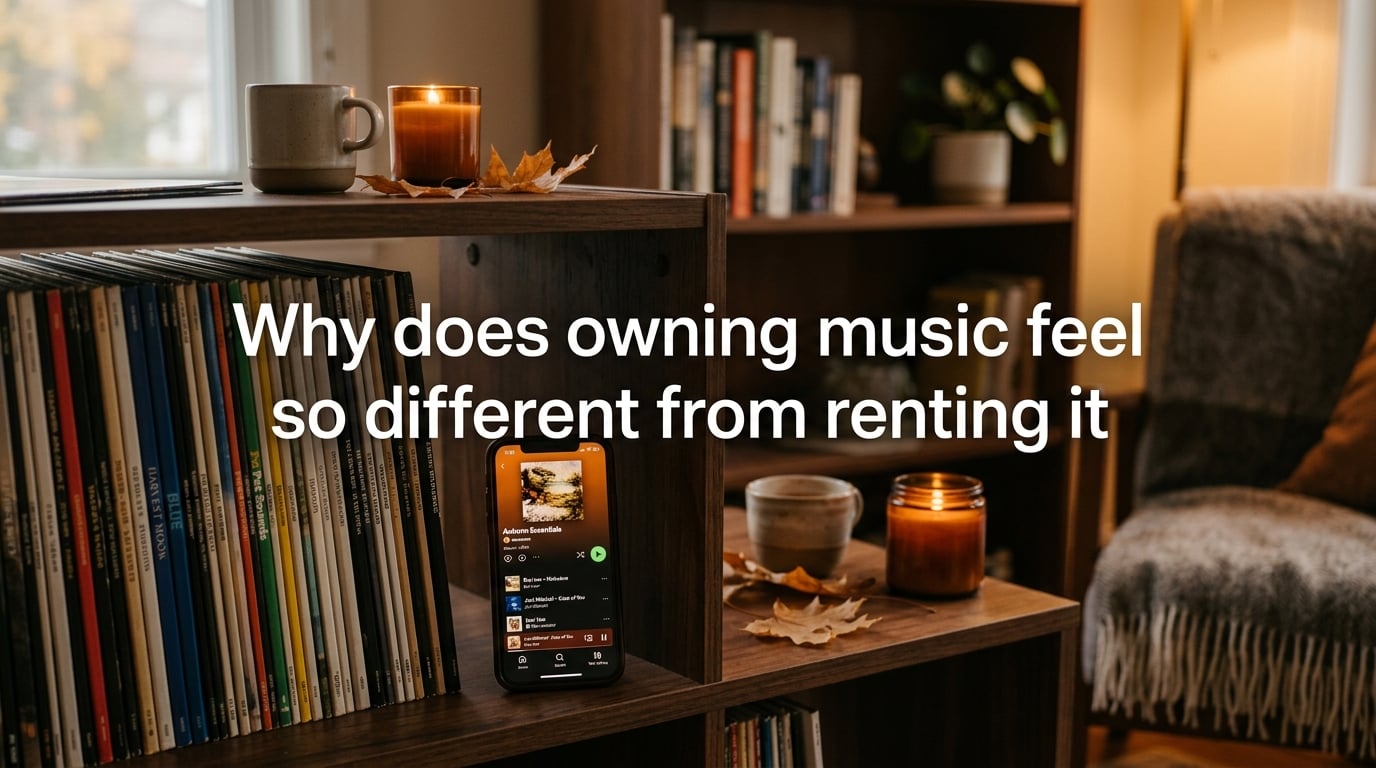
I’ve spent the last month asking one question out loud every time a song shuffles into my headphones: why does owning music feel so different from renting it? The playlist keeps spinning. The album I bought ten years ago still sits on the shelf, same artwork, same order, same quiet weight in my hand. One feels like weather. The other feels like a house.
This isn’t a nostalgia rant. I’m a paying subscriber to two streaming services and I use them daily. But the more I dug into the psychology, the cost math, and the way listeners actually behave in forums like r/audiophile and r/LetsTalkMusic, the clearer the picture became. Owning music and renting music are not two versions of the same thing. They’re two different relationships with sound.
In this guide I’ll walk through what each one actually gives you, why the difference runs deeper than monthly bills, and how to think about it without becoming the kind of person who yells about vinyl at dinner parties.
On this pageTable of Contents
- Why does owning music feel different from renting it
- How music went from object to access
- What renting gives you vs what owning gives you
- The ritual: why physical listening feels different
- The psychology of music ownership
- Music as identity, memory, and heirloom
- The cost reality: renting is not cheap over time
- When ownership really matters: Taylor Swift and the 35-year rule
- The hybrid model: stream to discover, own what matters
- Frequently Asked Questions
- Is owning music better than streaming?
- Is owning actually better than renting?
- Why are Gen Z buying vinyl?
- Why are people getting rid of Spotify?
- What is the 35 year rule in music?
- The music you keep
Why does owning music feel different from renting it
Owning music feels different from renting it because ownership engages the endowment effect (we value what we keep far more than what we merely access), turns listening into a physical ritual with artwork and liner notes, and lets music function as an autobiographical anchor we can lend, gift, and pass on. A rented library can vanish the moment a subscription ends; an owned one cannot.
That single sentence holds the whole answer, but the rest of this article unpacks each piece. The shift happens in three places at once: in your hand (a physical object), in your head (psychological ownership), and in your future (what survives after you stop paying).
I think most of us feel the difference before we can name it. We just don’t always trust the feeling, because streaming feels so modern, so frictionless, so reasonable. The feeling is real. The research backs it up.
How music went from object to access
For most of the 20th century, listening to music meant handling it. You drove to a store, you unwrapped a record or a CD, you read the liner notes while the first track played. Then, between roughly 2000 and 2015, the object almost disappeared. CD shipments in the United States collapsed from about 900 million units in 2000 to roughly 35 million by the early 2020s. The same decade that killed the CD built Spotify, Apple Music, Amazon Music, and Tidal.
The exchange rate looked unbeatable at the time. Ten dollars a month bought access to more music than any record store in history. No shelf space required. No flipping required. No commitment required.
What we didn’t notice in the moment was that “access” quietly replaced “ownership” as the default relationship. The Shorthorn made the same point bluntly: what began as a sleek, affordable revolution has, by 2026, become another rising monthly expense that gives you nothing to keep.
The pivot from object to access is the single biggest reason the two experiences feel different. One asks for your hand. The other asks only for your card.
What renting gives you vs what owning gives you
If you’ve ever tried to explain to a friend why you still buy records, you already know how slippery this gets. So let’s put it on the table. Here’s what each relationship actually delivers:
| Dimension | Renting (streaming) | Owning (vinyl, CD, lossless download) |
|---|---|---|
| Control | Service decides what stays in catalog | You decide, permanently |
| Permanence | Cancel = library disappears | Stays in your hands for life |
| Resale / gift | None | Sell, trade, lend, hand down |
| Ritual | Tap, scroll, skip | Unwrap, read, place the needle |
| Offline playback | Limited, tied to device + DRM | Works without internet, forever |
| Long-term cost | Recurring, no equity | One-time, retains some value |
| Album order | Algorithmic shuffle is default | Artist’s intended sequence preserved |
| Memory anchors | Playlist names, app UI | Cover art, sleeve, lyric sheet, shelf location |
The left column isn’t evil. Discovery, breadth, and “play anything right now” are real gifts. The right column isn’t pure nostalgia either. It’s a different kind of relationship, one that survives company mergers, price hikes, and the day you decide to cancel.
Notice how many rows are about time. Permanence. Long-term cost. What survives. Ownership is the side of the table that thinks in decades, not billing cycles.
The ritual: why physical listening feels different
A r/LetsTalkMusic thread put it perfectly: “Remember buying an album? Not just the music, but unwrapping the CD, pulling out the booklet, reading lyrics while the first track played. The album was an object in your life, not just something in an app.”
That object does something a stream cannot. It slows you down. You unwrap it. You read who produced track four. You notice the thank-you list, the studio, the city. By the time the needle drops or the disc starts spinning, you’ve already met the album once before the music begins.
Vinyl amplifies the friction further. You flip the record halfway through. You clean the stylus. You choose to be in the room for 18 minutes instead of leaving the music running while you scroll. Audiokeeper called this friction, and they were right that it is part of the appeal. Friction turns listening from background noise into an event.
Streaming solved access, but it turned music into something we use rather than something we have. Use is lighter. Have is heavier. Heavier is what most of us actually want from the songs that matter.
This is also why a Gen Z vinyl revival isn’t a hipster affect. Younger listeners grew up entirely on frictionless streaming, and the deliberate slowness of a record is a reaction, even a small rebellion, against consumption that asks nothing of them.
The psychology of music ownership
Two pieces of research explain almost everything about why ownership feels different.
The endowment effect. Once we own something, we value it more than an identical item we don’t own. The effect shows up in children as young as two to six, and it doesn’t go away with adulthood. When you hold a record you bought, your brain tags it as yours in a way a stream never quite manages, even if you saved the album to your library and listen to it every day.
The extended self. Psychologist Russell Belk proposed that our possessions are not just things we have; they are parts of who we are. A man’s self, William James wrote long before Belk, is the sum total of all that he can call his. Neuroscience backs this up: the medial prefrontal cortex, the region tied to self-identity, activates more strongly for items we own than for items we merely access.
Music is one of the most identity-loaded categories we own. The British Psychological Society noted that we can look at almost any object in our home and remember a chapter of our life attached to it. A record shelf is, quite directly, a chapter index.
Loss aversion makes this even stickier. We feel the pain of losing something we own about twice as strongly as the pleasure of gaining something equivalent. A subscription library you might lose tomorrow does not trigger that pain. A vinyl collection you might damage in a move absolutely does.
Put these three together and the feeling is overdetermined. We value what we own, we treat it as part of ourselves, and we dread losing it. Rented music touches none of those circuits.
Music as identity, memory, and heirloom
Oliver Sacks wrote that for patients losing memory to dementia, music often survives when almost nothing else does. People who can no longer recognize a spouse may still sing every word of a song from their teenage years. Music reaches parts of identity that other memory does not.
That isn’t an accident. Music is one of the strongest triggers of autobiographical memory we have. A playlist is, in practice, an audio diary: summer I turned 17, the year I moved, the drive to the hospital, the morning my kid was born. Streaming apps let us build those playlists. They don’t, however, let us hand them down. A vinyl crate can be inherited. A Spotify library cannot.
This is the heirloom angle that almost no competitor article touches. When someone in the family dies and the records get divided, those crates carry years of who-they-were into who-we-are. The question of what music we leave behind is the same shape as the question of what books, photos, or recipes we leave behind.
For parents thinking long-term, this is the case for ownership that goes beyond preference. The CD you buy today is something your kid might play in twenty years. The playlist you curate today disappears the moment you stop paying.
The cost reality: renting is not cheap over time
A Reddit user in r/audiophile did the math that most of us avoid. Five years of a single streaming subscription at roughly eleven dollars a month is about $650. Ten years is about $1,300. Twenty years, the span of a teenager’s whole adolescence into early adulthood, crosses $2,600. After all of it, the user wrote, “you own zero albums.”
For the same money, that user pointed out, you could own around 130 used CDs or albums, all permanent, all playable without an internet connection, all resellable if your taste changes.
This isn’t an argument to cancel streaming. Discovery is real, and no one is buying 130 albums a year to find a single new band they like. But the comparison reframes the question. Owning isn’t expensive. Renting is just deferred forever.
There’s a second cost that doesn’t show up on a credit card statement: fragility. Cancel the subscription and the library is gone. Change services and your carefully named playlists evaporate. The label pulls the artist’s catalog and the album you loved last year is suddenly greyed out, with no notice and no recourse.
Owned music has none of those failure modes. It does not depend on a single company staying solvent, on a single artist staying in a licensing deal, or on you remembering to renew anything.
When ownership really matters: Taylor Swift and the 35-year rule
If the difference between owning and renting ever felt theoretical, the Taylor Swift masters dispute made it concrete. When she left Big Machine Records in 2018, she did not own the recordings of her first six albums. She owned the songwriting. She owned the compositions. She did not own the masters.
Under U.S. copyright law, masters recorded before 1978 are protected for 95 years from publication. Recordings made after 1978 are protected for 70 years after the author’s death. That works out to roughly 35 years for most working artists, who record young. After that window, rights revert.
Swift’s response was to re-record the albums as Taylor’s Version, a deliberate act of taking ownership back through a legal workaround. The original masters are still not hers. They may eventually be, but only after the clock runs out.
The story is about an artist, not a listener, but it travels. If the person who made the music can lose the right to perform her own recordings, then the idea that a streaming platform gives you something close to “ownership” deserves a long, skeptical look. What a service sells you is a license to listen. That license is contingent on deals you will never see and probably cannot influence.
The hybrid model: stream to discover, own what matters
Almost no one I talk to about this wants to give up streaming entirely, and I’m not going to argue for it. The honest version of this argument is hybrid: use streaming for discovery, ownership for the music that becomes part of your life.
A practical split looks like this. Stream the new releases, the deep-cut rabbit holes, the algorithm-suggested neighbors. The moment an album crosses from liked to lived with, buy it in the format you actually want to live with. Vinyl if you want the ritual. CD if you want the cheapest lossless. A lossless FLAC or ALAC download from Bandcamp or the artist’s own store if you want the audio quality without the shelf.
The point isn’t which format you choose. The point is that you choose. That single choice is what ownership actually is, and it’s the thing a subscription quietly takes off the table.
Audiokeeper put it the way I keep coming back to: streaming solved convenience, but it did not replace the ritual. The hybrid model is what happens when a listener stops asking the two questions to do the same job.
Frequently Asked Questions
Is owning music better than streaming?
Owning music is better than streaming if you care about permanence, resale rights, offline playback, and the listening ritual. Streaming is better for discovery, breadth, and the lowest possible friction. The honest answer for most listeners is to use both: stream to find new music, own the albums that become part of your life.
Is owning actually better than renting?
Owning is better than renting when you measure over years instead of months. Five years of streaming costs roughly $650 with nothing to show; ten years is about $1,300. The same money can buy around 130 used albums that retain resale value and never disappear when a subscription ends.
Why are Gen Z buying vinyl?
Gen Z is buying vinyl because they grew up entirely on frictionless streaming and are responding to the deliberate slowness of a physical format. Vinyl introduces ritual, artwork, and intentional listening that on-demand apps do not. It is a reaction against consumption that asks nothing of the listener.
Why are people getting rid of Spotify?
People are canceling Spotify over subscription price increases, shrinking artist payouts, the loss of library access when a subscription ends, and frustration with algorithmic recommendations. Some also leave on principle after high-profile catalog disputes and changes to terms of service.
What is the 35 year rule in music?
The 35 year rule is shorthand for how long recording copyright typically lasts in practice. Under U.S. law, masters recorded after 1978 are protected for 70 years after the author’s death, which works out to about 35 years for most artists who record young. After that window, masters revert to the artist or their estate.
The music you keep
So why does owning music feel so different from renting it? Because ownership is the only version of music that lives in the same time you do. It survives the playlist app, the subscription price hike, the company that buys the catalog, the year you stop paying. It is the version that can be inherited.
Streaming is wonderful for what it is. Discovery has never been cheaper or wider. But the albums that made you who you are deserve more than a row in an app that may not exist next decade. They deserve a shelf, a file, a format that asks for your hand.
If you take one thing from this, take the hybrid: stream what you don’t yet love, own what you do. Then in twenty years, hand the crate to someone who needs it. That is the music that keeps.