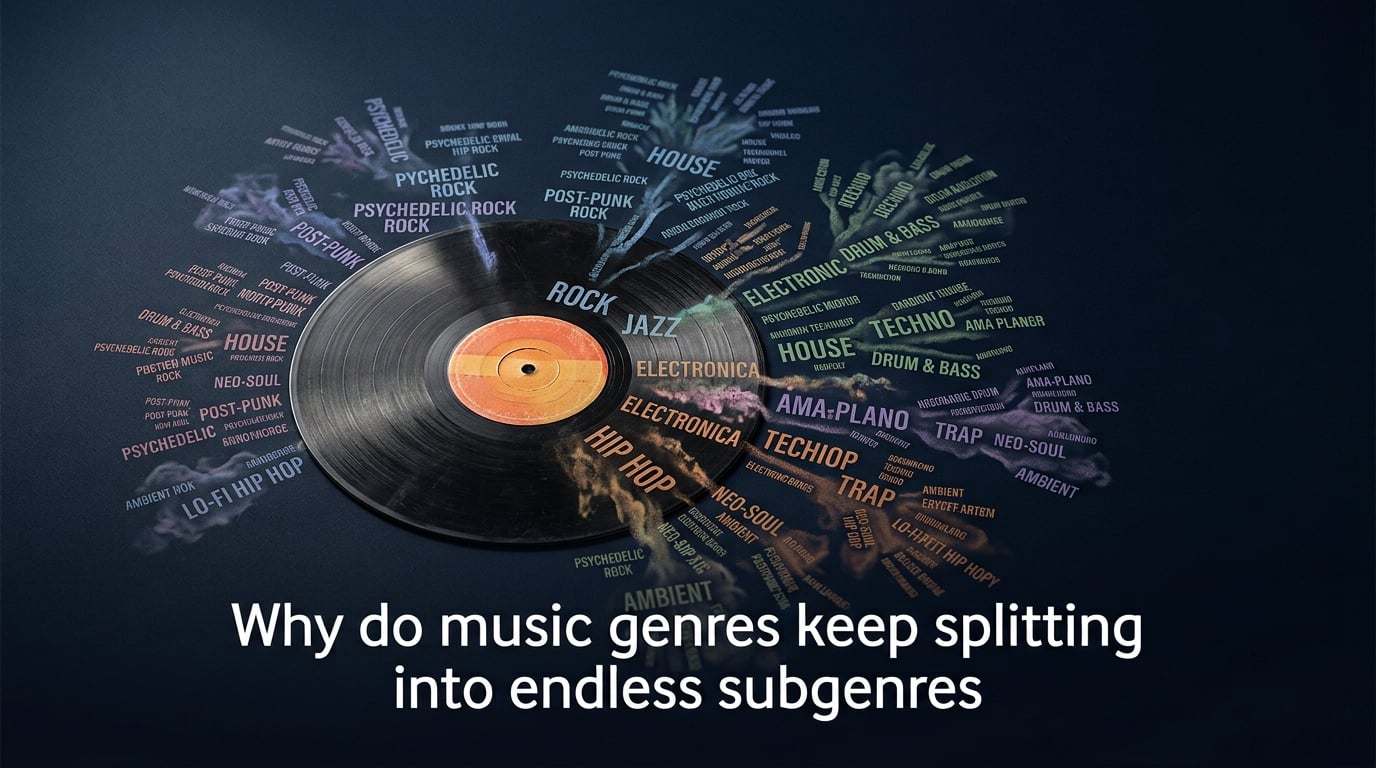
Music genres keep splitting into endless subgenres because five forces feed the explosion at once. Algorithmic tagging on streaming platforms rewards ever-narrower labels, regional scenes keep inventing local variants, the music press uses subgenre names as discovery shortcuts, artists borrow (or invent) micro-labels to stand out, and a recurring nostalgia cycle revives old sounds as new subgenres. Together they have pushed the number of named genres from about six in the 1970s to over 1,500 in 2026, according to Every Noise at Once.
On this pageTable of Contents
- What Is a Subgenre, and How Did We Get So Many?
- What Changed After the 1990s? The Algorithmic Explosion
- How Streaming Algorithms and Royalties Incentivize Specificity
- The Geography of Subgenres: Cities That Invented Their Own Sounds
- The 35-Year Rule and the Rise of Revival Subgenres
- Marketing, Identity, and the Music Press Shortcut
- Why Do Music Genres Keep Splitting? The Underlying Causes
- Is Over-Genrification Bad for Music? The Critique
- Frequently Asked Questions
- How many subgenres of music are there?
- What is the 35 year rule in music?
- What is the #1 genre in the world?
- What is Gen Z’s favorite music genre?
- Why does Gen Z like old music?
- What type of music do high IQ people listen to?
- How does Spotify decide what genre a song is?
- Will music genres keep multiplying?
- The Future of Genre: Will the Splitting Ever Stop?
What Is a Subgenre, and How Did We Get So Many?
A subgenre is a narrower category nested inside a broader music genre, defined by a specific combination of sound, scene, geography, or era. Chicago house is a subgenre of house, which is itself a subgenre of electronic dance music, which sits under the umbrella of dance music. The hierarchy keeps stacking because every artist working in a parent genre eventually pushes the sound in a direction that older listeners find strange and younger listeners find natural.
A micro-genre is the smallest workable version of that idea. It usually describes a sound so specific that only a few hundred musicians worldwide make it, and only a few thousand listeners recognize the label. Cloud rap, post-club, dreampunk, slap house, and Turkish psych-folk are all micro-genres. They work as in-group shorthand for fans who already know what the words mean.
A fusion genre is what you get when two different traditions meet. Afrobeat folded Yoruba percussion with funk and jazz. K-pop combines Korean pop vocals with American R&B, EDM drops, and hip-hop production. Latin hyperpop glues reggaeton dembow patterns to PC Music-style synthetic vocals. Fusion is one of the main engines of new genre creation because most listeners will accept a hyphenated label faster than they will accept a brand-new one.
In the 1970s, the genre list was short enough to fit on a record-store rack. Most stores carried rock, jazz, classical, pop, soul, country, folk, blues, reggae, disco, and a few smaller bins for gospel, easy listening, and soundtracks. By 2026, Every Noise at Once tracks more than 1,500 distinct genres, and Musicmap.info shows how each one branches from a handful of roots. That is a roughly 250-fold increase in named categories across about fifty years.
Two things made that growth possible: the technology to distribute, classify, and search very specific sounds, and the cultural pressure to label every micro-audience separately. Both of those are recent.
What Changed After the 1990s? The Algorithmic Explosion
The single biggest shift happened between 1999 and 2010, when MP3s, iTunes, and the first streaming platforms replaced the physical record store. A record store could fit maybe fifty bins. A digital catalog can fit millions of files, each tagged with as many subgenres as the platform wants to allow.
iTunes was the inflection point. When Apple shipped its Music Store in 2003, the company assigned every track to one of about twenty broad genres and several dozen subgenres. That gave publishers and producers a reason to lobby for placement in the most specific sub-bins they could fit, because the right subgenre meant appearing on the right browse page.
Beatport, which launched in 2004 to serve electronic DJs, took the idea much further. Beatport today lists house, tech house, deep house, Afro house, melodic house, organic house, minimal, tech trance, psy-trance, UK garage, bass house, electro, breakbeat, drum and bass, dubstep, and trap as separate top-level categories. Each splits further. Tech house alone has eight subcategories on the platform. The store’s founders reasoned that a DJ shopping for a specific crowd needs the right bin, and the bins multiplied to fit the demand.
Spotify arrived in 2008 and scaled the same logic to the entire popular music catalog. Behind the visible playlist layer is a system built on Music Information Retrieval, or MIR. MIR is the academic field that teaches computers to extract acoustic features from a recording: tempo, key, spectral centroid, vocal presence, energy, danceability, and hundreds more. Those features feed classifiers that assign each song to one of Spotify’s roughly 5,000 micro-genre tags, which then drive the recommendations, the radio stations, and the editorial playlist placement.
Audio fingerprinting services like AcoustID and the Gracenote database feed the same pipeline from the other side, matching a snippet of audio to a known release and pulling whatever metadata humans or algorithms have already attached. Once a song has been fingerprinted and tagged, that tag travels with the file forever, unless someone manually overrides it.
The result is a feedback loop. More music is uploaded, so more specific tags are needed to keep it sortable. More specific tags make the catalog browsable. Browsable catalogs pull in more listeners. More listeners generate more plays, which produce more data, which trains better classifiers, which generate even more specific tags. The taxonomy keeps branching because the system keeps rewarding new branches.
How Streaming Algorithms and Royalties Incentivize Specificity
The economics of streaming push artists toward micro-genres as well. On Spotify, the largest editorial playlists have millions of followers and send enormous amounts of traffic to anything they include. There are playlists called Lo-Fi Beats, Dark Academia Classical, and Crunk & Beyond. To get on one of those, an artist (or their distributor) has to file a pitch through Spotify for Artists that names the right genre, mood, and subgenre for the track. If the pitch names the wrong subgenre, the song is filtered out before a human curator ever hears it.
That filter creates a quiet pressure to be very precise. A band that sits somewhere between post-rock and doom metal gets nudged to declare itself one or the other, because the algorithm has a place for “Doom Metal Sludge” but not for “post-rock with doom influences.” The trade-off is real: a more specific tag can land a track on a smaller playlist with the right fans, but it can also lock the artist out of bigger, broader playlists that would have given them exposure.
Royalties magnify the same effect. Independent artists increasingly live or die by getting placed on niche playlists. A small Spotify playlist with 50,000 followers can pay for groceries. A niche playlist on YouTube Music or Apple Music can pull in supplemental income. Anything that improves playlist placement, including a more specific genre tag, is worth chasing.
Distributors know this. Services like DistroKid, TuneCore, and CD Baby walk artists through a tagging workflow before each release, and the genre dropdown now includes long lists of micro-genres that did not exist ten years ago. An artist releasing in 2026 can self-tag as “kawaii future bass,” “vapor trap,” or “dungeon synth” without needing a label’s permission. The system has been democratized, and so has the splitting.
Linguistic and identity-driven genres get the same treatment. Latin hyperpop, K-pop subgenres like “dark pop K-pop” or “crush K-pop,” and Afrobeats variants like “Afro-fusion” and “Afro-soul” all exist as named, tagged, playlistable categories because listeners search for those exact phrases and the platforms have learned to serve them.
The Geography of Subgenres: Cities That Invented Their Own Sounds
Long before algorithms arrived, regional scenes were already creating new subgenres by accident. Geography matters because cities tend to concentrate equipment (studios, clubs, record shops), mentors (older musicians willing to teach), and audiences (people willing to listen to unfamiliar sounds). When those three stack in one place, a new sound tends to emerge.
Chicago invented house music in the early 1980s. Frankie Knuckles and Larry Heard, working in the warehouse-club scene around Chicago, layered drum-machine beats with soulful vocals and disco samples. The term “house” came from the Warehouse club, and Chicago house became its own subgenre. It then split further into deep house, acid house, garage house, and ghetto house, each with its own scene and crowd.
Detroit invented techno at almost the same moment. Juan Atkins, Derrick May, and Kevin Saunderson, the so-called Belleville Three, drew on Chicago house, European synth-pop, and Kraftwerk to create something faster, colder, and more mechanical. Detroit techno became its own category, and from it branched minimal techno, dub techno, acid techno, and the harder sounds that fed the later rave explosion in Europe.
London gave the world UK garage in the late 1990s, which spun off into 2-step, speed garage, grime, and dubstep, each in a different London postcode. Grime in particular is a London sound. The MC battles, the pirate radio stations (Rinse FM, Déjà Vu FM, Kool FM), the specific 140 BPM tempo, and the laptop-based production all came out of East London housing estates. Grime then split again into subgenres like instrumental grime, wave grime, and eskibeat.
Atlanta built trap in the early 2000s. T.I., Jeezy, Gucci Mane, and later Migos and 21 Savage layered Southern hip-hop cadences over hi-hat-heavy 808 production. Atlanta trap became the global default for a kind of dark, energetic hip-hop. Trap later spawned drill, Brooklyn drill, Chicago drill, Afrobeats-influenced trap, Latin trap, and emo rap, each with its own geography.
Seoul created the modern K-pop production system, which combined American R&B vocal training, J-pop visual styling, EDM drops, and hip-hop choreography into a global export. Inside K-pop itself, subgenres have multiplied: dark pop K-pop, crush K-pop, retro K-pop, and K-indie all sit as recognized listener categories.
Lagos and London together built modern Afrobeats. Artists like Burna Boy, Wizkid, and Davido layered Yoruba and Pidgin vocals over Afrobeats, dancehall, and trap production. Subgenres like Afro-fusion, Afro-soul, Afropop, and Amapiano (which itself came from South Africa) now sit alongside it on playlists.
São Paulo produced baile funk, which merged Miami bass with Carioca samba, and later funk carioca, which then influenced the global rise of “phonk,” a micro-genre popular with meme culture and TikTok. Tokyo gave us J-core (Japanese hardcore techno), which has its own scene, festivals, and distribution networks. Each city added branches to the tree.
The 35-Year Rule and the Rise of Revival Subgenres
The 35-year rule in music is the observation that popular sounds tend to come back into fashion roughly 35 years after their original peak. Music made around 1980 (post-punk, synth-pop, new wave, early hip-hop) became a major influence on music made around 2015 (post-punk revival bands like Fontaines D.C., Shame, and Dry Cleaning, plus synthwave producers like The Midnight, FM-84, and Kavinsky’s film soundtrack work).
The cycle holds because the listeners who were teenagers during the original era become adults with cultural gatekeeping power, and the listeners who are teenagers during the revival are looking for sounds their parents did not colonize. 1970s rock got revived in the 2000s as “yacht rock.” 1980s synth-pop came back in the 2010s as synthwave and vaporwave. 1990s alternative and trip-hop are starting to come back in the late 2020s.
Each revival tends to invent its own subgenre label rather than reusing the old one, partly to signal that the new thing is not a reissue. Synthwave is not the same as synth-pop, even though they share instruments. Vaporwave is not synth-pop either; it uses slowed, chopped samples from 1980s and 1990s Muzak and corporate jingles to create a deliberately haunted, ironic sound. Post-punk revival bands share a lot of DNA with Wire and Joy Division but call themselves post-punk revival because the lineage matters.
The 35-year cycle explains why Gen Z keeps leaning on music from the late 1980s and early 1990s. TikTok’s algorithm surfaces old songs every time a new revival subgenre starts trending, and the feedback loop creates a wave. By 2026, the next big revival wave looks like it will lift mid-1990s alternative (Pavement, Smashing Pumpkins, Blur) and late-1990s trip-hop (Massive Attack, Portishead) into a fresh set of subgenre names.
Marketing, Identity, and the Music Press Shortcut
Genre names are also a marketing tool, and the music industry has always known it. SPIN magazine in the 1990s coined or popularized dozens of micro-labels because the magazine needed category names to organize reviews, and reviewers needed short labels to fit a headline. Pitchfork in the 2000s did the same thing on a much bigger stage, treating a clever subgenre coinage as a kind of byline.
Underground zines did it earlier and more locally. MaximumRocknRoll, the San Francisco punk zine, named dozens of crust punk, d-beat, and street punk subgenres before any mainstream outlet would touch them. Punk Planet, the Chicago-based zine, did the same for emo, midwest emo, and folk punk. Those names used to live only in photocopied fanzines; now they live on Spotify.
Some artists reject the labels altogether. Robert Fripp of King Crimson has spent decades refusing to call his music prog rock, even though everyone else does. Beth Gibbons and Geoff Barrow of Portishead have argued that calling their band trip-hop flattens what they actually do. Low, the Minnesota slowcore band, bristled at the slowcore label even when it was the most accurate description of their sound. The resistance is itself a kind of statement: the genre system is so overbuilt that even the artists it is meant to describe want to escape it.
Identity-based genres are the fastest-growing branch of the tree. K-pop subgenres, Afrobeats variants, and Latin hyperpop tags exist because listeners want to find music by language and cultural background as much as by sonic style. A teenager in São Paulo searching for “phonk brasileiro” or a listener in Lagos searching for “Afro-fusion” wants a tag that matches both the sound and the cultural line of credit. Streaming platforms have learned to serve those searches, which encourages more artists to tag themselves that way, which produces more genres.
Why Do Music Genres Keep Splitting? The Underlying Causes
Pulled together, the answer to the central question has seven parts. Music genres keep splitting into endless subgenres because:
- Streaming platforms reward precise tagging. Algorithms need sortable categories, and the catalog is too big for the old labels.
- Distribution technology removed shelf-space limits. A digital store can hold infinite bins, so the bins keep multiplying.
- Regional scenes produce local variants. Every major music city has its own sound, and each sound wants its own name.
- Artists use subgenre labels as marketing tools. A specific tag is easier to pitch to a curator than “sounds a bit like everything.”
- Music press relies on short category names. Reviewers and playlist editors need shorthand, so they coin or adopt micro-labels.
- A 35-year nostalgia cycle revives old sounds as new subgenres. Synthwave, vaporwave, and post-punk revival are recent examples.
- MIR and audio fingerprinting automate classification. Computers now assign genres faster than humans can argue about them.
Every Noise at Once, the algorithmic genre map maintained by Glenn McDonald, visualizes the result as a dense, interconnected cloud of more than 1,500 named genres. Musicmap.info shows the same explosion as a family tree. Both tools make the splitting feel less mysterious and more mechanical: the system is designed to split, so it splits.
Is Over-Genrification Bad for Music? The Critique
The same forces that created 1,500 genres also created four real problems. Listener fatigue is the first. New listeners trying to discover music now face a wall of unfamiliar terms before they ever hear a song. The barrier to entry for a micro-genre can be a paragraph of jargon.
Algorithmic pigeonholing is the second. Musicians complain on r/musicians and r/LetsTalkMusic that once Spotify tags them with a micro-genre, they cannot escape it. An artist who starts as a jazz pianist and later makes electronic music often finds that the recommendation system keeps pushing them to jazz listeners who do not want the new material. The first tag becomes a cage.
Tribalism and gatekeeping are the third. Sub-sub-genres often function as identity markers that exclude outsiders. Fans of one micro-genre mock the next micro-genre over for being too commercial, too soft, too derivative, or too experimental. The fights inside metal communities over the differences between death metal, melodic death metal, and metalcore are a familiar example. The energy that could go into listening goes into defending turf.
Curation disability is the fourth. DJs and playlisters have told me that the genre taxonomy is now so dense that building a coherent playlist requires either a very narrow focus or a very casual approach to labels. The middle ground, where most listeners actually live, has become harder to navigate.
The defenders of over-genrification have a real point, though. Sub-sub-genres are useful when they help a fan find a new sound quickly. “Post-punk revival” tells a listener what they are about to hear. “Chicago footwork” tells a dancer what tempo to expect. The shorthand works when both sides of the conversation already share context. It fails when one side does not, which is most of the time for new listeners.
Frequently Asked Questions
How many subgenres of music are there?
There is no fixed number, but the largest tracked list is Every Noise at Once, which catalogs over 1,500 named genres as of 2026. Musicmap.info adds another several hundred by counting genealogy branches. The actual number of useful subgenres depends on the listener: most people operate with 30 to 60 categories, while specialists in metal, electronic, or hip-hop may use hundreds.
What is the 35 year rule in music?
The 35-year rule is the observation that popular sounds tend to come back into fashion roughly 35 years after their original peak. Music made around 1980 (post-punk, synth-pop, new wave) became a major influence on music made around 2015 (post-punk revival, synthwave, vaporwave). The cycle continues because the listeners who were teenagers during the original era become cultural gatekeepers, and new listeners look for sounds their parents did not colonize.
What is the #1 genre in the world?
Pop is consistently the most-consumed genre globally when measured by streaming volume. Hip-hop and rap sit close behind, particularly in the United States, while Afrobeats, Latin music, and K-pop have grown fastest over the last five years. The leader changes by region: K-pop dominates in South Korea, Afrobeats leads in Nigeria and Ghana, reggaeton tops charts across Latin America, and European dance music remains strong across the EU.
What is Gen Z’s favorite music genre?
Surveys and streaming data point to hip-hop, pop, and a long tail of nostalgia-driven genres drawn from the late 1990s and early 2000s. Gen Z also over-indexes on micro-genres like hyperpop, bedroom pop, and lo-fi, and they treat genre as portable identity rather than fixed taste. Many Gen Z listeners maintain parallel playlists across several subgenres at once, which is itself a reflection of how fragmented the genre map has become.
Why does Gen Z like old music?
Gen Z reaches for older music partly because of the 35-year nostalgia cycle (a wave of 1980s and 1990s sounds has been cycling back), partly because TikTok surfaces older tracks to viral effect, and partly because older music feels less algorithmically processed. A song from 1997 has had decades to prove it stuck, which is a kind of quality filter the streaming era does not provide on its own.
What type of music do high IQ people listen to?
Research on music taste and cognitive measures is mixed, but studies have repeatedly found that instrumental and complex genres like classical, jazz, and ambient correlate with higher scores on certain cognitive tests. The correlation is weak and does not imply causation, and the genres overlap heavily with the preferences of people who simply had more exposure to music education as children.
How does Spotify decide what genre a song is?
Spotify combines human editorial tagging with machine learning. Songs uploaded through distributors carry self-reported genre tags that editors can correct, and Spotify’s algorithms analyze the audio using Music Information Retrieval features (tempo, key, spectral shape, vocal presence, energy) to assign and refine tags. Listener behavior (what playlists a song gets saved to, what other tracks listeners pair it with) further refines the model’s genre confidence.
Will music genres keep multiplying?
Probably yes, for as long as streaming platforms reward precise tagging and regional scenes keep producing new sounds. AI-assisted genre generation (where models invent and name entirely new micro-genres from raw audio) is already visible in early tools, and listener-defined micro-tags may eventually let audiences coin and vote on labels themselves. The genre tree will keep branching, though individual branches may have shorter lifespans than the genres of the past.
The Future of Genre: Will the Splitting Ever Stop?
The answer to why music genres keep splitting into endless subgenres is not one cause but a stack of causes: better technology for tagging, bigger catalogs, regional scenes producing local variants, music press using shorthand labels, artists chasing playlist placement, and nostalgia cycles reviving old sounds under new names. None of those forces is going away.
What is changing is the speed. AI-assisted genre generation, listener-defined micro-tags, and on-demand playlist curation mean the next 1,500 genres may appear in a fraction of the time it took to build the first 1,500. The genre tree of 2026 looks dense; the genre tree of 2030 may look like a thicket. Music will keep splitting, and listeners will keep finding their way through it, one micro-tag at a time.