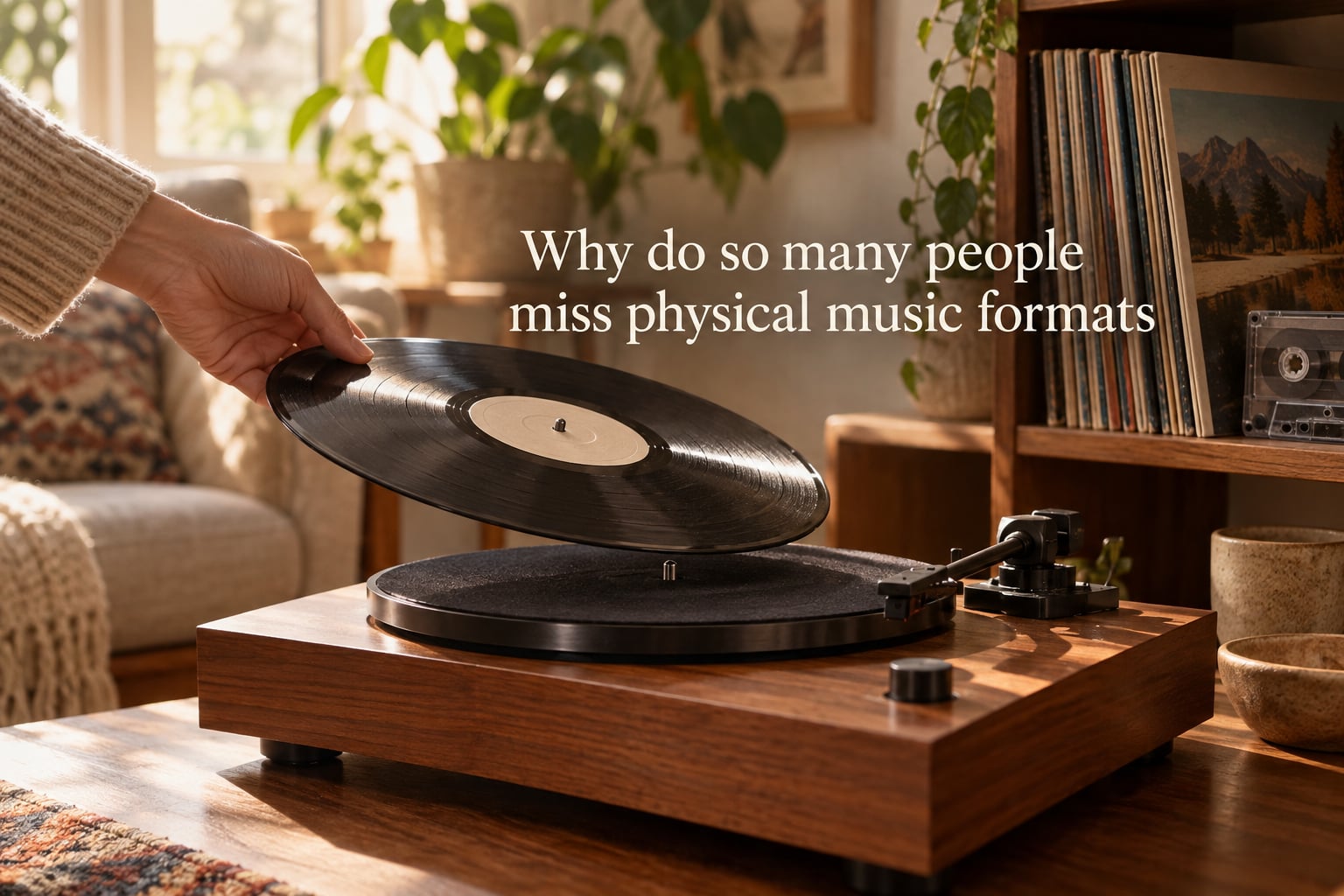
I still remember the crackle before the first track of my dad’s copy of Pink Moon. I was maybe eight, sitting cross-legged on the living room carpet while he lowered the needle with one hand and held the sleeve with the other. The room got quiet in a way that never happens when I tap “play” on a phone. That quiet is what I am chasing whenever I pull a record off the shelf now, and I think it is a large part of why so many people miss physical music formats.
Physical music formats are tangible audio carriers — primarily vinyl records (LPs and 45s), compact discs (CDs), and cassette tapes — that you can hold, own, and play on dedicated hardware like a turntable, CD player, or cassette deck. Streaming lives in the cloud; physical formats live on your shelf. That single difference is the seed of almost every reason people feel the loss.
Across thousands of posts on Reddit, Hacker News, and record-store forums, a clear pattern emerges. People miss physical music formats for seven overlapping reasons:
- The listening ritual — choosing, cleaning, cueing, flipping — turns music into an event.
- True ownership under the first-sale doctrine, free of DRM and remote deletion.
- The sound — analog warmth, dynamic mastering, and a different relationship with the groove.
- Album artwork and packaging designed at 12 inches, not thumbnail size.
- Nostalgia and memory tied to specific discs, decks, and family rituals.
- Community — record stores, Record Store Day, crate digging, trade lists.
- Intentionality in an age of algorithmic noise, autoplay, and infinite scroll.
The rest of this guide unpacks each reason, sorts out the formats, and gives you a practical way to start collecting in 2026 if you have been thinking about it.
On this pageTable of Contents
- What Counts as a Physical Music Format in 2026?
- Why the Listening Ritual Makes Physical Music Irreplaceable
- The Side A / Side B philosophy
- Tangible Ownership vs Streaming Access: What You Actually Keep
- The first-sale doctrine
- The streaming de-listing crisis
- Why Analog Warmth Beats Digital Precision for Many Listeners
- The case for cassettes
- The case for CDs
- Album Artwork and Packaging Are Part of the Music
- Liner notes as literature
- Why Physical Music Triggers Such Strong Nostalgia
- Vinyl, CDs, and Cassettes: How Each Format Earns Its Following
- Why vinyl leads the nostalgia conversation
- Why cassettes are coming back anyway
- Why CDs are quietly making a comeback
- The Vinyl Revival: Sales Data and the Year Everything Shifted
- Taylor Swift and the variant economy
- Gen Z and the digital-native collector
- Record Stores, Crate Digging, and the Culture Around Physical Music
- Local shops as cultural infrastructure
- Discogs, Bandcamp, and the long tail
- How to Start a Physical Music Collection in 2026
- Pick a format that fits your life
- Buy what you already love
- Use Discogs to avoid counterfeits and overpaying
- Take care of what you buy
- Frequently Asked Questions
- Why do people prefer vinyl records over digital music?
- Why is there widespread nostalgia for vinyl but not for cassettes?
- Why do people prefer vinyl over CDs?
- Is physical music making a comeback?
- Why does Gen Z like vinyl records?
- When did vinyl lose popularity?
- Which is better, cassette, CD, or vinyl?
- Why does music make me so nostalgic?
- Why Physical Music Will Keep Pulling People Back
What Counts as a Physical Music Format in 2026?
When people say “physical music formats,” they almost always mean three carriers: vinyl records, compact discs, and cassette tapes. Each stores audio differently and demands its own player.
Vinyl records press audio as a continuous analog groove into PVC. A stylus rides that groove, and the wiggles become voltage, and the voltage becomes sound. The standard 12-inch LP (33⅓ rpm) holds about 22 minutes per side; a 7-inch single (45 rpm) holds one song per side. Vinyl is the format people picture first when they hear “physical music.”
Compact discs (CDs) store audio as digital pits read by a 780 nm laser. The Red Book standard locks playback at 16-bit / 44.1 kHz, which was audiophile-grade in 1982 and still exceeds what most listeners need. CDs are small, durable, and ship with a booklet instead of a sleeve. Many of the ones sold between 1983 and 2005 are now in bargain bins for almost nothing.
Cassette tapes record audio as magnetic patterns on a thin polyester ribbon. The compact cassette (Type I, Type II, Type IV) and the micro-cassette are still around, and a real cassette-revival scene has been quietly growing since the late 2010s. Lo-fi charm and the mixtape tradition keep it culturally alive even though it never won the fidelity argument.
Other formats show up in deeper cuts — shellac 78s, 8-tracks, MiniDisc, DAT, DCC, even wax cylinders and pianola rolls for the truly historical. For 2026 listeners though, the conversation lives in the vinyl-CD-cassette triangle.
Why the Listening Ritual Makes Physical Music Irreplaceable
Streaming asks you to swipe. Vinyl asks you to commit. That is the heart of the ritual argument, and it is the reason many people say they listen more carefully to records even when they own the same album on every platform.
The mechanics are simple. You pull the record out of the sleeve. You set it on the platter. You cue the tonearm. You drop the needle. You wait a beat. Sound comes out of the speakers. When Side A ends, you flip the record. When the album ends, you decide whether to start it again or to be done for the night. There is no autoplay. There is no infinite queue. There is no thumb-flick into the next track at the 90-second mark.
A Hacker News commenter put it this way: “Buying a physical record requires some intent and choice which you don’t have in a Spotify catalogue of millions of tracks.” That intent is what makes the listening feel like a small event rather than background radiation. It is the same reason people light candles for dinner instead of eating in the dark with one hand on a phone.
The Side A / Side B philosophy
The 22-minute side is one of the most underrated ideas in 20th-century art. LPs were the dominant format from the late 1940s through the 1980s, and for those four decades every serious pop, jazz, and classical album was sequenced as two curated programs. Side A opens the statement. Side B closes it, sometimes with a surprise, sometimes with a long palette-cleanser track meant to be played loud.
When you stream a record-era album, the app queues everything into a single indifferent stream. The seams are invisible. The argument for vinyl is partly that those seams matter — that an album is a designed object, not a playlist, and that the design only works when you play it the way it was made.
CDs kept the same idea but broke the ceremony. Cassettes gave it a third side, the half-hour-per-side compact-cassette program. None of those formats could survive autoplay, so the moment the algorithm took over, the ritual retreated to the formats that resist it.
Tangible Ownership vs Streaming Access: What You Actually Keep
This is the part most nostalgia articles skip, and it is arguably the most important reason people miss physical formats in 2026. The cloud does not give you a music collection. It gives you access, and access can be revoked.
Streaming services have removed tracks from user libraries for licensing reasons, mastering disputes, and rights-holder changes. Albums have vanished overnight when a label’s catalog shifts to a competitor. Region locks have made entire discographies unplayable for travelers. A playlist you spent years building can shrink by a third in a quiet weekend.
One Reddit user summed it up after a string of streaming removals: “After Netflix cancelled a dozen shows I was watching, I ragequit and decided to funnel all my streaming service money into physical media.” That sentiment is now a movement. YouTube, Spotify, Apple Music, and Tidal all reserve the right to alter or remove any track at any time, and the contractual fine print says so plainly. The format you “own” is, legally, a revocable license.
The first-sale doctrine
Physical media in the United States is protected by the first-sale doctrine: once a copyright owner sells a copy, they cannot control what the buyer does with that specific copy. You can resell it, lend it, give it away, or play it until the grooves wear smooth. No streaming license in 2026 offers anything equivalent.
CDs and records are also DRM-free at the physical layer. You can rip them to your own hard drive for personal backup. You can re-encode them at the bit depth and sample rate of your choice. You can transcribe the music for analysis. None of that is possible with a streaming track, because the file is encrypted and the keys live on a server you do not control.
The streaming de-listing crisis
The scale of the de-listing problem is easy to underestimate. Tens of thousands of tracks have been pulled from major services over the last decade, often without notice and without replacement. Artists who fell out with a label have watched their catalogs disappear from Spotify overnight. Soundtracks, deep cuts, regional pressings, and niche genres are most at risk.
For a listener, the practical effect is that the only way to guarantee you can play a song in 20 years is to own the file or own the disc. Physical formats are not just nostalgic. They are the only archival-grade music storage ordinary people can buy.
Why Analog Warmth Beats Digital Precision for Many Listeners
There is a real technical difference between analog and digital audio, and there is also a real psychological difference, and the case for physical formats rests on both.
A vinyl groove is a continuous physical trace of the original waveform. It does not have a sample rate. It does not quantize amplitude into 65,536 steps. It does not require a low-pass filter at 22 kHz to mask imaging artifacts. It is, in a literal sense, a continuous representation of the music — within the limits of cutting and playback, of course. CDs store audio as 44,100 16-bit snapshots per second, which is more than enough resolution to be transparent for human hearing, but the path from number to analog voltage still passes through reconstruction filters and clocked DACs.
Whether vinyl sounds “better” than CD is a separate, harder question. Many well-mastered CDs are objectively cleaner than many well-cut vinyl records. But many modern records are also mastered louder and softer at different points so that the loud sections sound exciting on the turntable, and the quiet sections breathe. That choice — mastering for vinyl — tends to produce a more dynamic, less compressed listen than the typical streaming master.
The case for cassettes
Cassettes are the honest compromise of the three formats. They hiss. They wobble. They lose high frequencies with every play. They tangle in cheap decks. They are objectively the lowest-fidelity of the three. People who collect them in 2026 are not doing it for fidelity. They are doing it for the lo-fi warmth, the tape compression, the handmade feel, and the fact that a cassette sleeve fits in a jacket pocket in a way a 12-inch jacket never will.
For hip-hop, shoegaze, and ambient scenes, tape is a creative choice, not a backward step. Artists like Clipping., Oneohtrix Point Never, and Mount Eerie have released on cassette as part of the aesthetic, not in spite of it.
The case for CDs
CDs are the unsung middle child. They are smaller, more durable than vinyl, more navigable than cassette, and they often ship with booklets that hold lyrics, credits, and small art prints. The bargain-bin economics are absurd: a 1996 album that sold for $18 new is now $1 at any thrift store, and the disc inside is often identical to the original pressing.
For a new collector, CDs are also the lowest-cost, lowest-fuss entry into physical music. You do not need a turntable, a phono preamp, or a stylus budget. A $30 DVD player and a pair of headphones will get you a real, archival-quality listen.
Album Artwork and Packaging Are Part of the Music
Hipgnosis did not design Dark Side of the Moon for a 1-inch streaming thumbnail. Storm Thorgerson and Aubrey Powell designed it for a 12-inch square that you hold in two hands and look at while the needle cues the first track. That is part of the music. Stripping it out for a tile on a phone is closer to clipping a museum painting down to a postage stamp.
Vinyl’s 12-inch canvas changed how album covers were designed. Peter Saville could use a tiny photograph at full scale for Unknown Pleasures. The gatefold could hold a 24-inch panoramic photograph, lyrics printed large enough to read across the room, and a fold-out poster. Even modest records got a printed inner sleeve, a center label, and a run-out etch in the dead wax.
CDs kept some of that with the booklet, but the smaller format forced art directors to compress. Cassettes shrunk it further. Streaming shrinks it to nothing. When you ask people what they miss about physical music, a startling number answer with specific covers: the rough linen of a Mobile Fidelity sleeve, the embossed foil of an In Utero reissue, the bright insert card of a Merge 7-inch.
Liner notes as literature
Liner notes were a literary form. Musicians wrote essays, thanked the people who mattered, and gave credit to engineers, session players, and the aunt who made the cover. Today, a “thank you” goes in a Spotify bio in 280 characters. The shift is small in bytes and enormous in feeling.
Why Physical Music Triggers Such Strong Nostalgia
Music and memory are neurologically intertwined. The auditory cortex processes sound, and the hippocampus tags emotional moments, and the two systems write to each other constantly. That is why a song you have not heard in 15 years can put you back in a specific room of your childhood in a way a photograph cannot.
Physical music adds a second layer of memory to that mix. The disc itself is part of the memory. The scratch on Side B, Track 3, that you got from your sister’s backpack. The coffee ring on the sleeve of the album you played the morning after a breakup. The Philips CD player that played your bedtime music when you were small. The tape deck in your dad’s truck. A streaming service cannot do that. The cloud is identical for everyone, and the identicalness is the opposite of nostalgia.
One r/GenX user wrote: “Decades of playing in and going to shows have blown my hearing anyway lol but I do still get the experience of handling physical media with vinyl.” That is the whole case in one sentence. The music is one thing. The handling is another. The handling is the part you remember.
Vinyl, CDs, and Cassettes: How Each Format Earns Its Following
Each format pulls a different crowd for a different reason. A quick comparison helps sort it out.
| Dimension | Vinyl (LP) | CD | Cassette |
|---|---|---|---|
| Sound character | Analog warmth, dynamic, mastering-dependent | Clean digital, 16-bit / 44.1 kHz, can sound bright | Lo-fi, tape compression, hiss |
| Listening ritual | Strongest (flip every 22 minutes) | Medium (whole album, no flip) | Medium (flip every 30–45 minutes) |
| Ownership | Yes, first-sale, no DRM | Yes, first-sale, no DRM | Yes, first-sale, no DRM |
| Artwork | 12-inch, gatefolds, inserts | Booklet, often small but complete | J-card, minimal but personalizable |
| Durability | Sensitive to scratches, dust, warping | Very durable, sensitive to deep scratches | Tape stretches, tangles, demagnetizes |
| Cost to start | High (turntable + amp + speakers) | Low (any CD/DVD player works) | Low (used portable decks are cheap) |
| Typical collector | Audiophile, indie rock, jazz, classical | Metal, prog, classical, bargain hunters | Hip-hop, shoegaze, ambient, tape-only releases |
The headline is that no format wins on every dimension. Vinyl wins on ritual and artwork. CD wins on archival durability and entry cost. Cassette wins on portability and personal character. Most serious physical-format collectors end up with at least two.
Why vinyl leads the nostalgia conversation
Vinyl gets the most airtime because the format itself is the most legible. A record is visibly a record. The motion of the platter is hypnotic. The sleeve is large enough to frame and hang. Cassettes look like leftovers from a Walkman era, and CDs look like data discs. Vinyl still feels ceremonial.
Why cassettes are coming back anyway
Cassette sales have grown for several years running, and a small but real scene has formed around limited-edition runs from indie labels. The drivers are mostly cultural: the mixtape tradition, the lo-fi aesthetic, the small-run economics that let an artist press 50 tapes and sell them at a show. For artists, cassettes are also the most affordable format to produce, which matters in a music economy where streaming payouts are vanishingly small.
Why CDs are quietly making a comeback
CD sales ticked up in 2026 for the first time in over two decades, driven by the same ownership-and-archival logic that powers the vinyl revival, plus the simple fact that decades of used CDs are available at near-zero prices. Collectors who care about a deep, full, well-mastered library at low cost are quietly rediscovering the format.
The Vinyl Revival: Sales Data and the Year Everything Shifted
The numbers tell the story faster than any essay can. According to RIAA mid-year figures, vinyl revenue in the United States crossed the billion-dollar line for the first sustained run in the modern era in the early 2020s and has continued to grow every year since. In 2023, vinyl outsold CDs by revenue for the eighth straight year. By 2026, vinyl is again the largest physical music category by a wide margin.
The BPI reports a similar story in the UK, with vinyl sales now exceeding 5 million units annually and the format generating more revenue than paid streaming’s per-unit value for many back-catalog titles. Record Store Day UK regularly moves hundreds of thousands of units in a single April weekend.
Taylor Swift and the variant economy
No discussion of the 2026 vinyl market is complete without acknowledging Taylor Swift’s outsized role. Midnights, 1989 (Taylor’s Version), The Tortured Poets Department, and The Life of a Showgirl have all shipped in four to six colored-vinyl variants, each with a unique photo, lyric insert, or bonus track. The result is a variant economy that drives a meaningful share of total vinyl sales and gives casual fans a reason to own multiple physical copies of the same album.
The variant model is divisive. Some listeners see it as cynical marketing. Others see it as the only major-label response that actually moves physical units. Either way, it is now the dominant strategy for new-release vinyl at the top of the charts.
Gen Z and the digital-native collector
The most surprising data point is demographic. Surveys from Music Watch and the BPI consistently show that the single largest age cohort of new vinyl buyers in 2026 is under 25. Gen Z did not grow up with vinyl. They grew up with Spotify. And they are buying turntables anyway.
The drivers are a mix of cultural rejection of algorithmic feeds, the same digital burnout that pushed people back to print books and film cameras, and the social-media appeal of records as visual objects on a shelf or in a “vinyl of the day” Reel. For a generation that came of age with playlists, the album-as-object is a fresh discovery.
Record Stores, Crate Digging, and the Culture Around Physical Music
No one falls in love with vinyl in a fulfillment center. They fall in love with it in a record store, on a Saturday, with a coffee in one hand and a Discogs app in the other, holding a copy of Unknown Pleasures up to the light to check the run-out etch.
Record Store Day, founded in 2008 in the US and rolled out internationally in 2009, is the single biggest annual event for the format. Independent shops open early, line up around the block, and sell exclusive releases that never get a wide pressing. For many of the people in line, it is the closest thing to a music festival they will attend all year.
Local shops as cultural infrastructure
Independent record stores are also where most physical-music culture actually lives. They host in-stores, take trades, run listening parties, and curate staff picks that surface music streaming algorithms would never recommend. When a town loses its record store, it loses more than a retailer. It loses the place where a 14-year-old hears their future favorite record for the first time.
Discogs, Bandcamp, and the long tail
Online, the physical-music community runs on Discogs for catalog data and secondhand sales, Bandcamp for direct artist support and limited physical runs, and a long tail of label websites that ship pre-orders with hand-numbered jackets. None of these are as convenient as Spotify. All of them are part of why the scene is healthy.
How to Start a Physical Music Collection in 2026
Starting a collection is easier, more affordable, and more fun than it has been in years. A few simple rules get you going without burning out.
Pick a format that fits your life
If you want the deepest ritual, start with vinyl and budget for a turntable, a phono preamp (or a turntable with one built in), and a pair of speakers. A solid entry setup runs about $400–$600 in 2026 and will outlast any streaming subscription you have ever had.
If you want the lowest friction and the deepest catalog, start with CDs. Any used DVD or Blu-ray player will play them, and thrift stores in most cities have rooms full of discs for a dollar each. You can build a 200-album library in a weekend.
If you want the most character per dollar, start with cassettes. Used Walkmans and portable cassette decks are cheap, and indie labels run small-batch tape editions that arrive in the mail with hand-stamped J-cards. It is the most personal entry point.
Buy what you already love
The single best piece of advice for a new collector is to buy physical copies of albums you already stream constantly. You already know you like them. You will play them. The first ten records you buy should be yours, not some critic’s top-100 list.
Use Discogs to avoid counterfeits and overpaying
Discogs’ price-history tool and community grading notes are the best protection against overpaying for a reissue or buying a counterfeit. Always check the seller’s rating and the pressing’s catalog number before you click buy.
Take care of what you buy
Vinyl wants a clean stylus, an anti-static brush, and a shelf out of direct sunlight. CDs want a soft sleeve and a case. Cassettes want a pencil to rewind them and a deck that has been demagnetized in the last decade. A little care extends a physical collection by decades. Neglect shortens it.
Frequently Asked Questions
Why do people prefer vinyl records over digital music?
People prefer vinyl records over digital music because the format turns listening into a deliberate ritual rather than a background tap. The act of choosing a record, cleaning it, cueing the stylus, and flipping the record every 22 minutes forces active attention. Vinyl also tends to be mastered for wider dynamic range than streaming masters, which often makes albums feel more alive on the turntable.
Why is there widespread nostalgia for vinyl but not for cassettes?
Vinyl draws more nostalgia than cassettes because the format itself is more legible as a cultural object: a 12-inch sleeve with a visible label and a moving platter is iconic in a way a plastic clamshell is not. Cassettes do have a smaller but real nostalgia scene, mostly built around the mixtape tradition, lo-fi aesthetics, and small-batch indie releases.
Why do people prefer vinyl over CDs?
People prefer vinyl over CDs because vinyl offers a stronger ritual, larger artwork, and mastering choices that often produce a more dynamic listen. CDs win on durability, portability, and price, so the two formats tend to attract slightly different collectors rather than one replacing the other.
Is physical music making a comeback?
Yes, physical music is making a comeback. RIAA and BPI data show vinyl revenue has grown every year since the early 2020s, vinyl again outsells CDs by revenue, and CD sales ticked upward in recent years as well. Cassette sales have grown for several years running, driven mostly by indie labels and small-batch editions.
Why does Gen Z like vinyl records?
Gen Z likes vinyl because the format rejects algorithmic listening in favor of a deliberate, album-shaped experience. Surveys consistently show that the largest cohort of new vinyl buyers in recent years is under 25, drawn by the format’s visual appeal, its resistance to autoplay, and the same digital burnout that has pushed younger listeners back to print books and film cameras.
When did vinyl lose popularity?
Vinyl lost popularity in the late 1980s after the introduction of the compact disc, with the format’s market share falling by more than half between 1988 and 1992. Sales continued to decline through the 1990s and 2000s as CD and then MP3 and streaming became dominant, before reversing in the early 2010s.
Which is better, cassette, CD, or vinyl?
No format is strictly better. Vinyl offers the strongest ritual and largest artwork. CDs offer the cleanest sound, the smallest footprint, and the lowest entry cost. Cassettes offer the most personal character and the cheapest entry point for new artists. Most serious collectors end up with at least two of the three.
Why does music make me so nostalgic?
Music triggers nostalgia because the auditory cortex and the hippocampus write to each other constantly, so sounds heard during emotionally charged moments get tagged with extra memory weight. Physical music adds a second layer: the disc, the sleeve, and the specific scratches or wear marks become part of the memory in a way a stream cannot.
Why Physical Music Will Keep Pulling People Back
People miss physical music formats for reasons that are simultaneously practical and emotional. They miss the ownership that the cloud cannot give. They miss the ritual that the algorithm cannot replicate. They miss the artwork, the liner notes, the dynamic mastering, the hiss of a tape, the weight of a 12-inch sleeve. They miss the small act of choosing one album and listening to it all the way through.
If you have been thinking about starting a collection in 2026, the simplest move is also the best one. Pick the format that fits your life, buy one album you already love, and play it from start to finish without your phone in your hand. The rest tends to take care of itself.