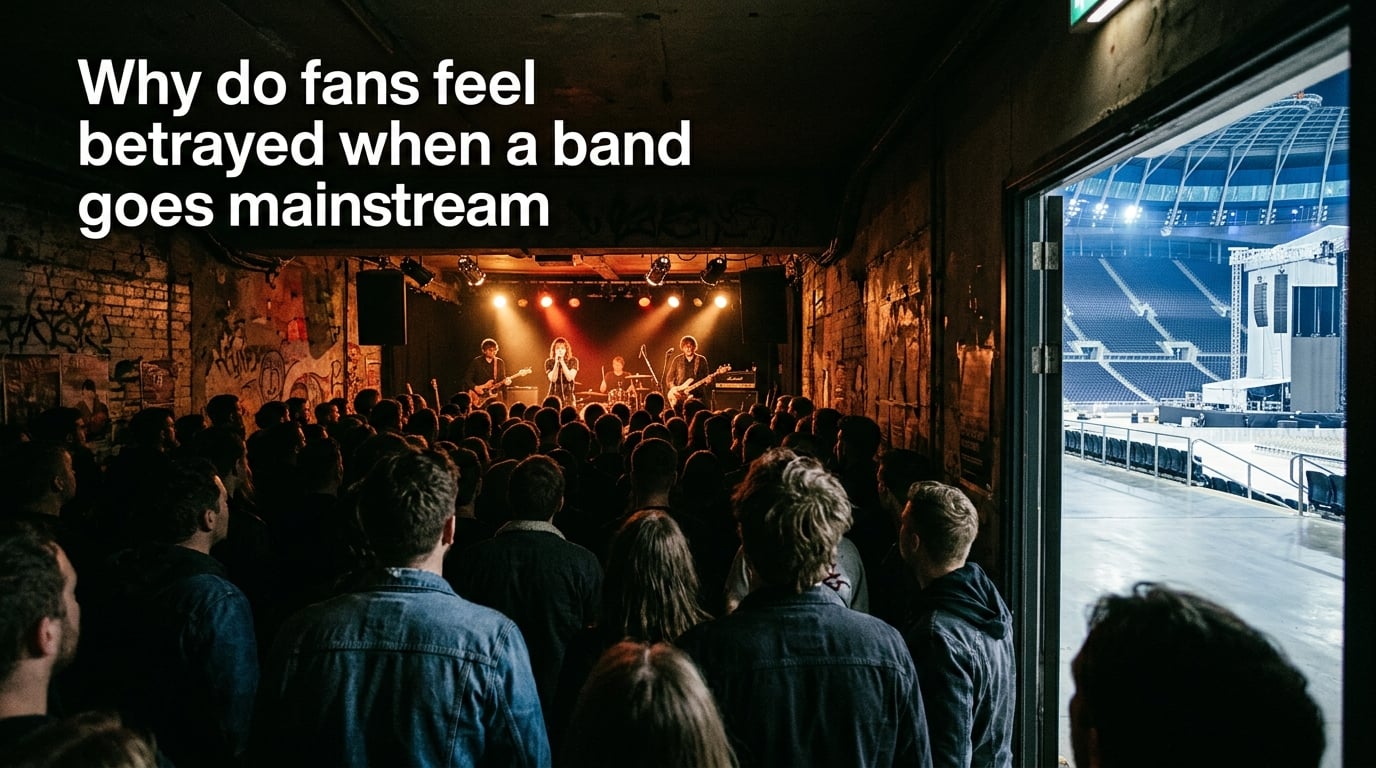
Fans feel betrayed when a band goes mainstream because the shift toward broader commercial appeal threatens the listener’s identity and sense of ownership. Once a fan “owned” an underground act, mainstream success erases that exclusivity and makes the band’s outsider status, the very thing the fan bonded with, disappear overnight.
I have watched this happen more times than I can count. A small band plays a 200-cap room, the room sings every word, and the front row treats the band like theirs. Three years later that band is on a major label, the songs are tighter, and the same fans are posting furious threads about how the band has “sold out.” It is not really about the new sound. It is about the loss of something the fan quietly carried as part of who they are.
This guide unpacks why that betrayal feels so personal, where it comes from psychologically, and what it means when a band crosses the line from underground to mainstream. We will look at famous examples, the difference between selling out and natural artistic evolution, and why some bands escape the hate while others take the full force of it.
On this pageTable of Contents
- What “Selling Out” Actually Means in Music
- Why Fans Feel Betrayed When a Band Goes Mainstream
- The Parasocial Bond Between Fans and Underground Bands
- Subcultural Identity and the Loss of Outsider Status
- Label Pressure vs. Natural Artistic Evolution
- Famous Bands That Got Called Sellouts
- Why Some Bands Escape the Hate
- Is “Selling Out” Really a Betrayal?
- Frequently Asked Questions
- What does it mean when a band sells out?
- Why do some bands get hate for going mainstream while others do not?
- Is selling out really that bad?
- What bands sold out the most?
- Do bands owe fans their original sound?
- The Takeaway on Fan Betrayal When a Band Goes Mainstream
What “Selling Out” Actually Means in Music
Selling out is the accusation that an artist has compromised their creative integrity for commercial success, usually by signing a major label deal, shifting toward radio-friendly production, chasing sync licensing, or making an image overhaul to broaden their audience.
The term is older than most of the bands it gets thrown at. It picked up its current moral weight in the 1980s and 1990s as indie and punk scenes built their identity around rejecting the mainstream. Once a band accepts corporate money, the logic goes, they can no longer be trusted to mean what they say.
But here is the part most fans skip: changing your sound is not the same as selling out. Bands grow, members mature, and production gets better with budget. The accusation only sticks when listeners believe the change was made to chase popularity rather than to follow an honest creative impulse. That distinction is where every argument on r/LetsTalkMusic eventually lands.
Why Fans Feel Betrayed When a Band Goes Mainstream
The betrayal is real, and it usually comes from a small cluster of psychological triggers.
Identity threat. Fans who discovered a band in a tiny venue quietly built that band into part of their self-image. When the band pivots to a wider audience, the fan feels a piece of their own identity has been rewritten without permission.
Loss of exclusivity. The band’s value was partly that not everyone had heard them. Mainstream success deletes that scarcity. Being a fan used to mean you were tuned in; now everyone is.
Ownership violation. Early fans feel they helped fund the first tour, the merch pre-orders, the late-night demos. When the band then courts a new, bigger audience, the original supporters feel displaced, like they paid the rent and got evicted.
Parasocial bond rupture. A one-sided emotional bond between fan and artist builds up over years of lyrics, interviews, and stage banter. A sudden commercial pivot feels like a friend announcing a personality transplant.
None of these reactions are irrational. They are predictable responses to a real social shift, and naming them is the first step to handling them without spiraling.
The Parasocial Bond Between Fans and Underground Bands
The term parasocial relationship was coined by Donald Horton and R. Wohl in 1956 to describe the one-sided intimacy audiences feel with media figures. You “know” the host of a show you have watched for years, even though they have no idea who you are.
Bands exploit this dynamic on purpose, or accidentally. Lyrics are written in second person. Band members thank the same small crowds by name. Meet-and-greets blur the line between celebrity and friend. By the time the band gets big, the bond is already loaded with feelings that the band never formally agreed to carry.
When that bond breaks, the pain is closer to a breakup than a business disappointment. The fan is not really mad that the band signed with a label. They are hurt that the relationship they thought they had feels suddenly unavailable.
Subcultural Identity and the Loss of Outsider Status
Subcultural theory, the academic kind developed by Dick Hebdige in Subculture: The Meaning of Style (1979) and Sarah Thornton in Club Cultures (1995), says that music scenes are built on the same in-group and out-group psychology that drives every other tribe. The scene defines itself by what it is not, and being “in” requires taste signals outsiders cannot fake.
Psychologists Henri Tajfel and John Turner formalized this in social identity theory: people derive part of their self-esteem from the groups they belong to, and they protect that group from outside contamination. New fans arriving after a band goes mainstream are experienced as dilution, even invasion.
This is why fans on r/Metalcore react so differently to Architects evolving smoothly versus Asking Alexandria pivoting hard. Both bands changed. Architects kept their scene credibility by evolving gradually and in ways the in-group could read as authentic. Asking Alexandria tripped the in-group alarm because the change felt too fast, too commercial, too out of character.
Label Pressure vs. Natural Artistic Evolution
Not every sound change is a betrayal, and learning to tell the difference saves you a lot of angry posts.
Natural evolution usually looks like this:
- The band’s songwriting matures over multiple albums, not in one sudden jump.
- New members or life events drive the change.
- Lyrics shift alongside the sound, not just the production.
- The band acknowledges its history and credits its roots.
Commercial pivot usually looks like this:
- One album reads as a sharp course correction timed to a label push.
- The new sound is suspiciously well suited to current playlist trends.
- Visual identity, interviews, and merch all get the same polish at once.
- Original fans are quietly priced out of VIP tiers and tour meetups.
If a band checks the second list, the fan anger has a real target. If it checks the first list, the band is probably just growing up.
Famous Bands That Got Called Sellouts
A few cases that come up constantly in fan arguments, with the rough consensus each one carries:
- Maroon 5 — From a scrappy LA rock band to polished electropop. The pivot after Songs About Jane is the textbook case fans reach for.
- Metallica — The 1991 Black Album. Metalheads still argue that the moment they signed with a major and cut their hair, the band lost its edge.
- Bob Dylan — Going electric at Newport in 1965. One fan famously shouted “Judas!” at the Manchester Free Trade Hall the next year. Often cited as the original mainstream betrayal.
- Jawbreaker — Signing with DGC and releasing Dear You in 1995. Fans treated the polished album as a betrayal so intense that the band broke up within months.
- Green Day — Even after American Idiot brought a new wave of fans, the band’s signing with a major in 1994 still gets dragged up in every Reddit thread.
- Asking Alexandria — Their 2010s pivot away from metalcore toward arena rock made them a frequent target on r/Metalcore.
Notice the pattern. Every name on this list kept making music people were listening to. The accusation does not really track sales, it tracks vibe.
Why Some Bands Escape the Hate
Some artists change their sound just as dramatically and barely get called out. Motionless in White evolved from horror-themed metalcore into something closer to radio rock and kept a surprising amount of goodwill. The same is true for Bring Me the Horizon, who moved from deathcore to pop-electronic across a decade.
The difference usually comes down to a few specific things:
Gradualism. Bands that change one album at a time, slowly, let their fanbase adjust. Bands that drop a whole new identity in a single record cycle shock the in-group.
Scene credibility. Members who stayed visible in the scene, kept touring small venues, kept crediting the bands that influenced them, get a longer leash.
Public acknowledgment. A short, sincere “we know where we came from” goes a long way. Bands that visibly forget their roots lose goodwill faster than bands that visibly remember.
Authentic creative reasons. Listeners can usually tell whether a shift came from a real artistic impulse or from a label strategy meeting. The former gets grace. The latter gets Reddit threads.
Is “Selling Out” Really a Betrayal?
Sometimes, yes. A clear commercial pivot that abandons the band’s identity to chase trends deserves the criticism. More often, the betrayal is partly a projection. The fan wanted the band to stay small because being a fan of a small band was part of who the fan was. That is a reasonable feeling, but it is also a feeling the band did not agree to manage.
Confirmation bias plays a role. Some fans were always going to find a reason to feel betrayed, because the betrayal, not the music, was doing the emotional work. Survivorship bias warps things too. We mostly remember the bands that did pivot badly. We forget the thousands of bands who grew up musically without anyone noticing.
The accusation itself is also fading. In a streaming era where most artists earn fractions of a cent per play, the line between “selling out” and “paying rent” has blurred. On r/LetsTalkMusic and elsewhere, more listeners admit the moral panic has become rare. Bands need revenue. Most bands were never going to stay small forever.
You are allowed to like the new music. You are allowed to outgrow the old music. The healthiest fans are the ones that separate the band they discovered from the band the artists are now. Both can be good. Both can be real.
Frequently Asked Questions
What does it mean when a band sells out?
Selling out is the accusation that an artist has compromised their creative integrity for commercial success. It usually points to a major label deal, a pivot toward radio-friendly production, image overhauls, or chasing sync licensing deals that broaden the audience but feel forced to longtime fans.
Why do some bands get hate for going mainstream while others do not?
The bands that escape fan backlash usually change gradually, keep their scene credibility, acknowledge their roots, and let listeners see a genuine artistic impulse rather than a label strategy. Bands that pivot abruptly, polish everything at once, and forget their early fans tend to take the full force of the sellout accusation.
Is selling out really that bad?
Sometimes yes, when a band clearly abandons its identity to chase trends. More often it is partly projection from fans whose own identity was tied to the band staying small. Naming that projection is the first step to processing it without guilt.
What bands sold out the most?
Maroon 5, Metallica with the 1991 Black Album, Green Day after their 1994 major label signing, Jawbreaker with Dear You in 1995, and Asking Alexandria in the 2010s come up most often. Bob Dylan going electric at Newport in 1965 is the original historical reference point.
Do bands owe fans their original sound?
No. Artists are allowed to evolve musically, change members, and explore new sounds. Fans are also allowed to lose interest. The implicit social contract between a band and its early fans is real, but it does not legally or morally lock either side into a fixed sound.
The Takeaway on Fan Betrayal When a Band Goes Mainstream
Why fans feel betrayed when a band goes mainstream comes down to identity, exclusivity, and a one-sided emotional bond that was never really a contract. The feeling is real, it is predictable, and it is mostly about what the fan carried, not just what the band did.
Our team’s best summary: the sellout accusation works best when it is aimed at a sudden commercial pivot that ignores the band’s roots, and it falls apart when it is aimed at any artist who simply grew up. The bands that change gracefully tend to keep their fans. The bands that change carelessly tend to lose them, and they usually deserve to.
If you are processing your own version of this right now, take a breath. The music you loved was real. The new music can be real too, on its own terms, or you can walk away without apology. Both are valid. The betrayal only wins if you let it crowd out the songs.