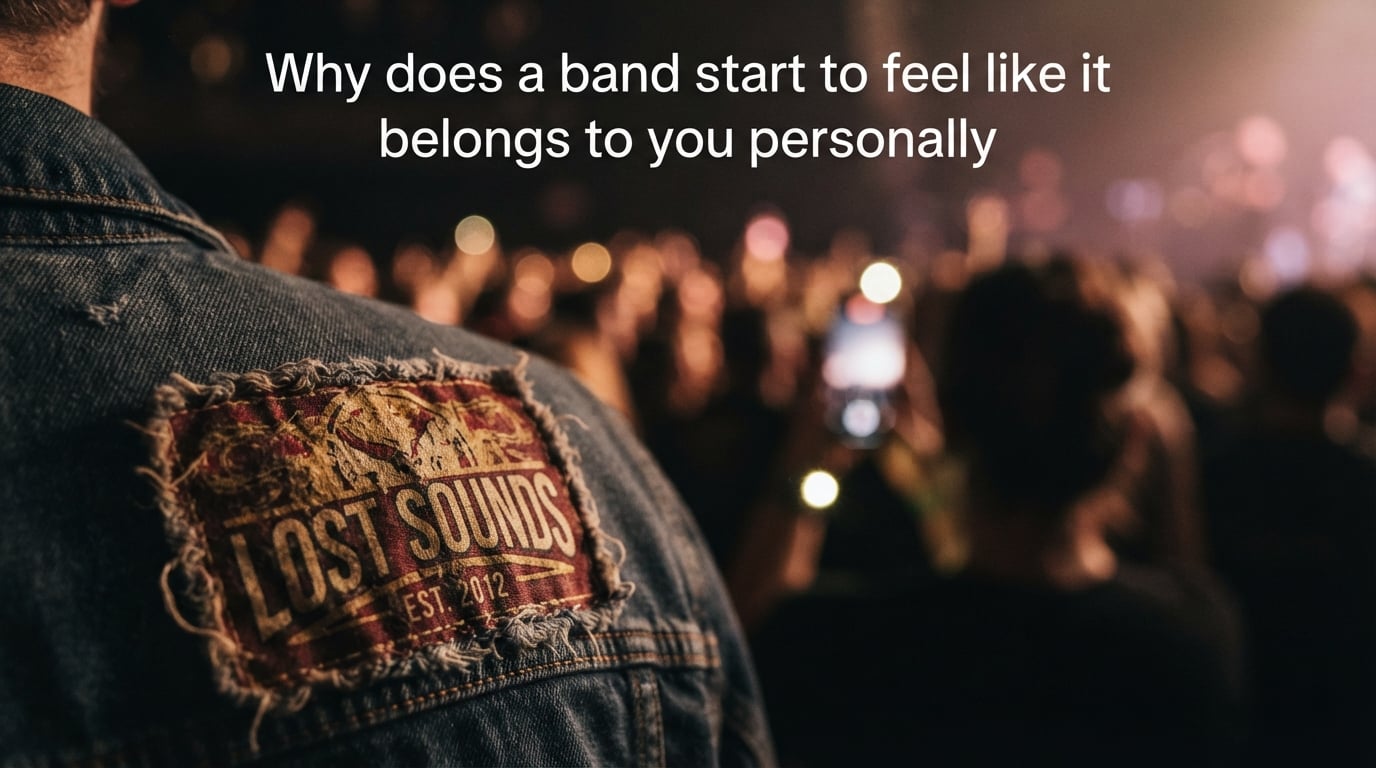
Why does a band start to feel like it belongs to you personally? It happens because music becomes wired to your autobiographical memory, your social identity, and a parasocial bond with the artists. Three psychological mechanisms work together to turn “a band I like” into “a band that is part of me.” Once those circuits are lit up, a song stops being background sound and becomes a marker of who you are.
I’ve spent the last few months digging into the psychology behind this feeling, talking to fans, and reading what researchers have published on music, memory, and identity. What follows is what I found, written for anyone who has ever felt a jolt of protectiveness when a friend dismisses their favorite band.
On this pageTable of Contents
- The Three Psychological Forces That Make a Band Feel Like Yours
- Autobiographical memory: how songs tag themselves to life chapters
- Dopamine and reward circuitry: the brain marking the band as good for you
- Social identity theory: fandom as in-group membership
- When the Bond Forms: The Timeline From First Listen to Identity Marker
- First listen: the imprint moment
- First concert: the embodied ritual
- Life-chapter soundtrack: when a song anchors a memory
- Adolescence as the peak identity-formation window
- Why Criticism of Your Band Feels Like a Personal Attack
- Identity threat response
- Reactions from r/ENFP and r/infp communities
- Protectiveness as a healthy identity signal
- Healthy Ownership vs Parasocial Obsession: Where the Line Sits
- Signs of healthy fandom ownership
- Warning signs of parasocial fixation
- Permission to call a band yours without apology
- When the Bond Breaks: Grief, Burnout, and Drifting Away
- Mourning an artist you never met
- Burnout from over-listening during a heavy chapter
- Drifting away from a band that defined a season
- Frequently Asked Questions
- Why do I feel emotionally connected to music?
- How does music influence personal identity?
- Why do fans feel ownership over their favorite band?
- Is it rare to have frisson from music?
- Why does criticism of my favorite band feel personal?
- The Feeling Is Real, and It Is Worth Understanding
The Three Psychological Forces That Make a Band Feel Like Yours
A band starts to feel personally yours for three reinforcing reasons: your brain tags the music to specific life chapters, your reward system marks the band as pleasurable, and your social circle treats the fandom as a form of group identity.
Autobiographical memory: how songs tag themselves to life chapters
The hippocampus is the brain’s memory librarian, and it has a special shelf for music. Songs heard during emotionally charged moments get filed alongside the memory itself, so every later listen drags the original scene back into view. That is why hearing your first breakup song years later can drop you straight back into the same room, even down to the weather outside.
Researchers call this music-evoked autobiographical memory, and it is unusually sticky. Oliver Sacks documented this in dementia patients who could no longer recognize family but could still sing every word of songs from their teens. The songs outlived the explicit memories, because they had been encoded into procedural and emotional circuitry as well as the narrative one.
Dopamine and reward circuitry: the brain marking the band as good for you
When a song you love comes on, your nucleus accumbens releases dopamine. The same release pattern lights up for food, sex, and social approval, which is why your favorite band can feel chemically rewarding in a way that has nothing to do with objective musical quality.
Anticipation matters too. A 2026 APA Monitor review noted that self-selected music strongly engages reward and identity circuits, and that the strongest dopamine hits often come a beat or two before the chorus drops. Your brain learns to predict the payoff, then rewards you for the prediction coming true. Repeat that loop a few hundred times across a song, an album, and a tour cycle, and the band becomes a habit your nervous system treats as essential.
Social identity theory: fandom as in-group membership
Henri Tajfel’s social identity theory says we define ourselves partly by the groups we belong to. A favorite band is one of the cheapest, lowest-commitment groups you can join, and it still delivers real in-group benefits: shared vocabulary, insider references, and a sense of belonging.
Wearing a band shirt at a concert is the simplest demonstration. You spot other people in the same shirt, you nod, and your brain registers them as your tribe for the next two hours. A Greater Good piece on music bonding has shown that synchronized singing and rhythm actually release endorphins, which means your body is rewarding you for being part of the group, not just for the music.
When the Bond Forms: The Timeline From First Listen to Identity Marker
The “this band is mine” feeling rarely appears all at once. It usually builds across a recognizable timeline, from first listen through life-chapter soundtrack to identity marker.
First listen: the imprint moment
The first time you hear a song that hits, your brain takes a snapshot. Context matters: where you were, who you were with, what was happening in your life. That snapshot becomes the emotional template for every later listen, which is why you can love a band for decades on the strength of a single early impression.
First concert: the embodied ritual
A first concert is the moment a band stops being audio and becomes an event. Standing in a crowd, singing choruses with thousands of strangers, your mirror neurons fire along with everyone else’s. The memory is stored not just in the brain’s narrative system but in the body, which is why you can recall the exact temperature of the venue years later.
Life-chapter soundtrack: when a song anchors a memory
Most fans can name the songs that played during a friendship, a breakup, a move, or a loss. Those tracks become signposts. Later, the song is the doorway back to the chapter, which is why sharing it can feel like handing someone the key to your house.
A user on r/DoesAnybodyElse put it this way: their favorite songs feel like hidden gems, and sharing them feels like giving away the value. That is not greed; it is autobiographical memory protecting itself.
Adolescence as the peak identity-formation window
Identity-formation peaks between ages 12 and 22, which is also when most people lock in their long-term music preferences. A band you bond with at 15 often stays “your band” for life, because the brain is using it as raw material to build the self. This is why a song from your teens can hit harder than one you discovered last year, even if the newer one is technically better.
Why Criticism of Your Band Feels Like a Personal Attack
When someone says your favorite band sucks, your brain does not always hear a music review. It can register the comment as a rejection of part of who you are, which is why the response is often a flash of anger, not a calm disagreement.
Identity threat response
Social psychologists call this an identity threat. The band has become a category the listener belongs to, and an attack on the category reads as an attack on the self. An r/Music user described it cleanly: “your brain doesn’t always hear a review of the music. It can feel like they’re rejecting a piece of your identity.”
Reactions from r/ENFP and r/infp communities
Personality does not cause the bond, but it can amplify it. Listeners high in introverted feeling often describe their favorite music as a personal value system rather than a hobby. Insult the band and you are insulting a value, which lands much harder than a stylistic disagreement.
Protectiveness as a healthy identity signal
Protectiveness is not a red flag on its own. It usually means the band is doing what identity-forming media is supposed to do: giving you something stable to rally around. The signal becomes a problem only when the protectiveness starts dictating who you talk to or how you treat people who disagree.
Healthy Ownership vs Parasocial Obsession: Where the Line Sits
Calling a band “mine” is normal and psychologically healthy. Treating the band’s members as property is not. The difference usually shows up in behavior, not feelings.
Signs of healthy fandom ownership
Healthy ownership looks like: feeling proud when someone you know gets into the band, defending the music in conversations, returning to old albums during tough seasons, and feeling grief if an artist dies. None of that requires the artist to know you exist.
Warning signs of parasocial fixation
Parasocial obsession shows up when the fan starts to believe the relationship is mutual. Tracking the artist’s movements, treating their personal life as public property, or feeling entitled to their time and attention are signs the bond has tilted into territory psychologists flag as risky. A Shining Awards piece on the parasocial trap notes that imagined connections can spiral into fixation when fans start to believe their love gives them rights over the artist’s privacy.
Permission to call a band yours without apology
Most listeners sit firmly on the healthy side of that line. A Quora thread on music fandom captures it well: fans of lesser-known bands describe feeling part of an exclusive club, and that is the in-group effect working exactly as designed. The band is yours in the same way your hometown is yours: a place that shaped you, not a possession.
When the Bond Breaks: Grief, Burnout, and Drifting Away
Bonds form, but they also strain. Three common endings show up across fan forums.
Mourning an artist you never met
When a bonded artist dies, fans report grief that surprises them with its intensity. A Reddit user described losing an artist they had followed for 15 years as “grieving like a friend, even though we never met.” That is the autobiographical-memory system doing its job: the music was tagged to a long stretch of your life, so the loss touches that whole stretch.
Burnout from over-listening during a heavy chapter
Tying a band to a breakup or a loss can backfire. The songs become time machines you did not ask to enter, and eventually you stop listening not because you stopped loving the band but because you cannot afford the memory trip. r/MetalForTheMasses users describe this burnout pattern often: the band did not get worse, the listener just got full.
Drifting away from a band that defined a season
Sometimes you simply grow past a band. The music still sounds fine, but it no longer maps onto your current life. That drift is not betrayal; it is the same identity-formation process in reverse, with new music taking over the role of “soundtrack to who I am right now.”
Frequently Asked Questions
Why do I feel emotionally connected to music?
Music lights up the same brain regions that handle emotion, memory, and reward. Songs heard during meaningful moments get filed alongside those memories, so every later listen drags the original scene back into view. That is why a track from your teens can feel more emotionally real than one you discovered last week.
How does music influence personal identity?
Music works as an identity marker through social identity theory: the bands you like signal who you are, and the fans you share them with become part of your in-group. Over time, the soundtrack of your adolescence gets woven into how you see yourself, so a favorite band often feels less like a hobby and more like a category you belong to.
Why do fans feel ownership over their favorite band?
Ownership feeling comes from autobiographical memory, dopamine reward, and in-group membership stacking on top of each other. Once a band has soundtracked key life chapters, released pleasure chemicals in your brain, and signaled your social tribe, calling it mine is just the brain describing what is already true.
Is it rare to have frisson from music?
Frisson, the goosebump response to music, is not rare. Studies put the share of listeners who report it somewhere between 60 and 90 percent, and people who score higher on openness to experience tend to feel it more often. It is one of the clearest signals that your reward and emotion circuits are firing together.
Why does criticism of my favorite band feel personal?
Because the band has become part of your identity, not just your taste. Insulting the music can register as insulting a value the listener has built their sense of self around. The protectiveness is usually a sign the bond is doing what identity-forming media is supposed to do, and only becomes a problem when it starts controlling how you treat people who disagree.
The Feeling Is Real, and It Is Worth Understanding
So why does a band start to feel like it belongs to you personally? Because your brain uses music to remember, to reward, and to locate yourself inside a tribe. Three systems, working together, turn “a band I like” into “a band that is part of me.” That is not delusion; it is what music is for.
If you have ever felt defensive about a favorite band, or surprised by how much an artist’s death hurt, you can stop wondering whether the bond is real. It is real, and now you know the machinery behind it.