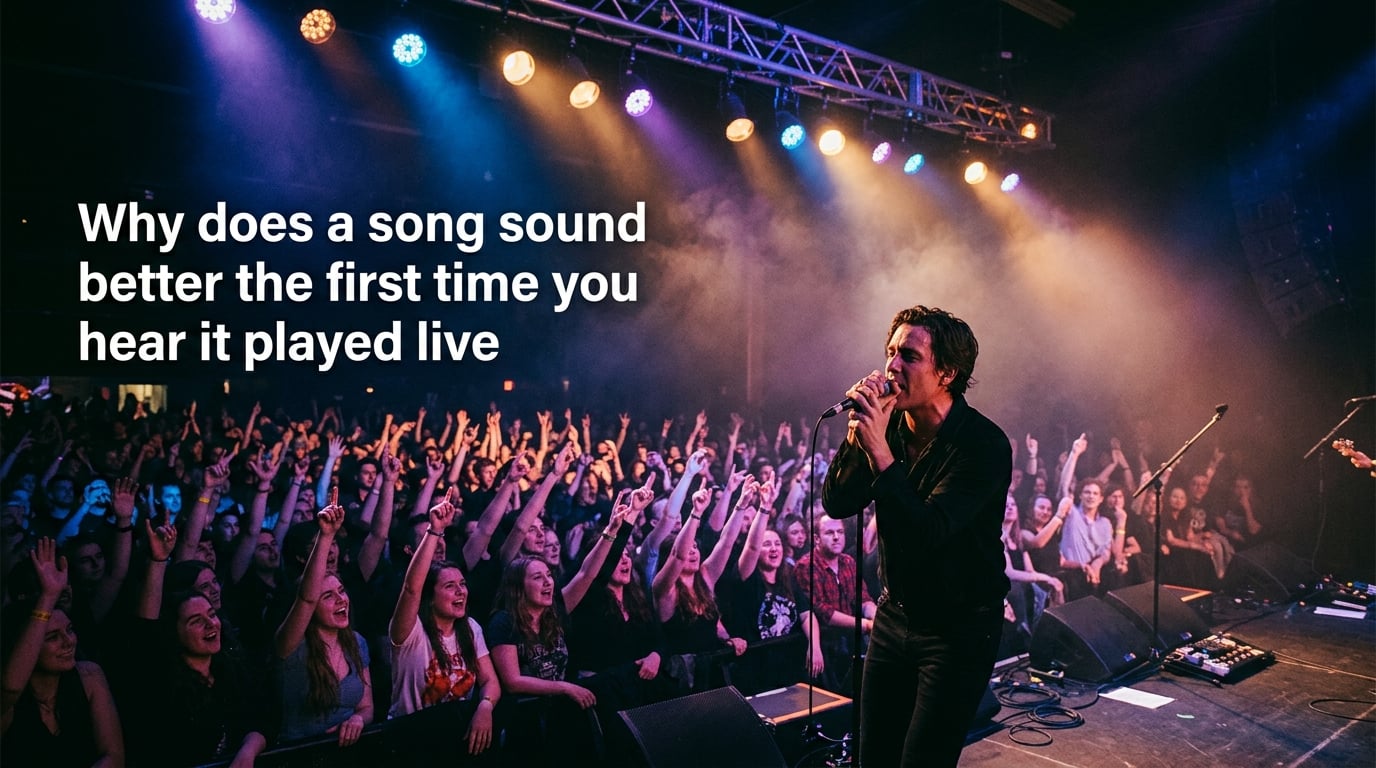
Why does a song sound better the first time you hear it played live? Two things hit your brain at once: the novelty of a first listen triggers a dopamine reward, and the live environment adds physical arousal, crowd energy, and unpredictability that a recording cannot reproduce. The combination of first-listen euphoria and live-only sensory input creates a moment your brain tags as special.
I still remember the first time I heard a favorite song live. I had streamed it at least two hundred times. Yet when the opening notes hit in a packed room, my whole body reacted like the song was brand new. That gap between two hundred home listens and one live moment is exactly what this article is about.
Our team dug into the neuroscience, the music psychology research, and the live-event factors that combine to make a first live listen feel different from every other way you can hear a song. Here is what we found.
On this pageTable of Contents
- Why does a song sound better the first time you hear it live
- How the brain rewards a first live listen
- The dopamine surge and reward prediction error
- Familiarity plus surprise as the sweet spot
- Why live is different from recorded music
- Loudness, crowd, and physical arousal
- Unpredictability you cannot replay
- The body joins in: frisson, goosebumps, and adrenaline
- Why the feeling is so hard to recreate at home
- Listener differences: age, openness, and expectations
- Frequently Asked Questions
- Why do live songs sound better?
- Why do live versions of songs sound better?
- What is the 3 minute rule in music?
- What is the 80/20 rule in songwriting?
- What happens in your brain when you hear a new song live?
- Savoring the first-listen moment
Why does a song sound better the first time you hear it live
A first live listen feels better because novelty, anticipation, and physical arousal hit the brain in the same instant. Your reward system releases dopamine when a song surprises you just enough to feel like discovery, while the live setting adds sensory input that headphones cannot match.
Seven factors stack on top of each other in that moment:
- First-listen dopamine. The brain treats a genuinely new song like a small reward.
- Live unpredictability. Musicians change tempos, add solos, and improvise, so your brain cannot fully predict what comes next.
- Crowd synchrony. Hundreds of people reacting together amplifies your own emotional response.
- Higher loudness and bass. Concert sound systems engage the body, not just the ears.
- Visual focus on the artist. Seeing the musician perform locks your attention in a way audio alone does not.
- Anticipation built from setlists and pre-show hype. Your brain has been predicting this moment for hours or days.
- One-time-only pressure. You know this exact performance will never happen again, so your brain treats it as a rare event.
Each factor on its own makes a song feel a little better. Stacked together, they create the live first-listen rush that fans chase for years.
How the brain rewards a first live listen
The core mechanism is dopamine release in the brain’s reward system. Dopamine is the neurotransmitter your brain uses to tag experiences worth remembering, and music is one of the strongest non-survival triggers we know of.
The dopamine surge and reward prediction error
Neuroscientists describe the trigger as a reward prediction error. Your brain constantly compares what it expected to hear with what it actually hears. When reality is slightly better than the prediction, dopamine fires.
On the first listen, every chord change and lyric is a small prediction error. The brain is learning the shape of the song while the song is happening, and each confirmation produces a tiny dopamine pulse. By the thirtieth listen, the prediction error has collapsed to almost nothing, and the dopamine response drops with it.
Live music resets that mechanism in two ways. The musicians play the song differently from the studio version, so even a song you know cold contains fresh prediction errors. The crowd, the lighting, and the room acoustics add unpredictable inputs your brain has to process on the fly.
Familiarity plus surprise as the sweet spot
Research from Professor Adrian North at Heriot-Watt University suggests we like music best when it sits in a middle band of complexity. Too unfamiliar and the brain cannot find a pattern. Too familiar and the pattern is already solved, so there is no reward for listening.
A first live listen lands almost perfectly in that middle band. You know the song well enough to predict the verse and the chorus. You do not know exactly how tonight’s version will go. That tiny gap between expectation and surprise is where first-listen euphoria lives.
Why live is different from recorded music
Live music feels better than a recording even when the recording sounds technically cleaner, because the live version adds a sensory layer that headphones and speakers cannot fully deliver.
Loudness, crowd, and physical arousal
A concert sound system can hit 100 to 110 decibels at the front of the crowd. At that level, sound becomes a physical sensation you feel in your chest, not just hear in your ears. Studies on arousal and music show that higher loudness increases heart rate, skin conductance, and reported emotional intensity.
The crowd adds a second amplifier. When the people around you sing, clap, or fall silent at the same moment, your nervous system starts to synchronize with theirs. That shared arousal is one of the strongest emotional triggers humans have, and a recording strips it out completely.
Unpredictability you cannot replay
Recorded music is frozen. The drum fill on the album is the same drum fill every time. Live, the fill is different, the pause before the chorus is different, the guitarist might stretch a solo for an extra eight bars.
Your brain treats unpredictability as information. Every small variation demands attention, and that attention is what keeps the reward system firing throughout the song instead of settling into autopilot after the first chorus.
The body joins in: frisson, goosebumps, and adrenaline
About half of all people experience frisson, the chills or goosebumps triggered by a powerful musical moment. Frisson is a real physiological event: piloerection, a measurable shift in skin conductance, and a small dopamine release in the same reward circuits that respond to food and social bonding.
Live music dramatically raises the odds of frisson. Visual cues, anticipation, and crowd energy all prime the body to react. Add the adrenaline of being in a packed venue, and the threshold for that physical response drops. People who rarely get chills at home will often get them at a concert.
Adrenaline plays a supporting role. Even a relaxed concertgoer has a slightly elevated heart rate from being in a crowd, walking to the venue, and waiting for the show to start. That baseline arousal makes every emotional peak feel taller than it would at home on the couch.
Why the feeling is so hard to recreate at home
You can buy the best headphones, the best speakers, and the highest-resolution streaming tier, and the home version still feels flatter. The reason is not sound quality. It is the missing ingredients.
At home, your brain does not have to track crowd movement, read the performer’s face, or share the moment with strangers. There is no adrenaline, no anticipation built from a setlist, and no one-time-only pressure. The novelty of the song itself has usually burned off long before you get home and put it on.
Audiophile forums often argue that a well-recorded live album should close the gap. The honest answer from listeners in those threads is that it rarely does. The recording captures the sound, but not the live event around the sound, and the brain notices the missing layer even when the ears do not.
Listener differences: age, openness, and expectations
Not everyone feels the first-listen rush equally. Personality research links higher scores on openness to experience with stronger emotional responses to music and a greater willingness to seek out new songs. People who score lower on openness often need many more listens before a song lands.
Age plays a role too. Younger listeners tend to be in a life stage packed with first encounters, new bands, and first concerts, so they get more chances to feel the rush. Older listeners can absolutely still feel it, but the ratio of first listens to repeat listens drops, and the moments that do land tend to feel rarer and more precious.
Pre-show hype cuts both ways. Strong anticipation increases the brain’s prediction error when the moment arrives, which usually makes the live first-listen feel bigger. But if expectations are set too high, the reality can fall short, and the same factors that produce euphoria can flip into disappointment. Honest framing helps: go in curious, not convinced.
Frequently Asked Questions
Why do live songs sound better?
Live songs sound better because the brain combines a first-listen dopamine reward with physical arousal, crowd energy, and unpredictability that recordings cannot deliver. Loudness, visual focus, and shared reactions all push the emotional response higher than home listening can usually reach.
Why do live versions of songs sound better?
Live versions feel better than studio recordings because musicians change tempos, add solos, and improvise, which creates small prediction errors that fire the brain’s reward system. Add crowd synchrony, higher volume, and the one-time-only feeling of a real performance, and the same song lands harder than the album version.
What is the 3 minute rule in music?
The 3 minute rule is a radio-era guideline that songs should stay close to three minutes long to keep listeners engaged and fit broadcast formats. It is a commercial rule, not a science rule, and it explains why many hit songs cluster around that length rather than stretching to five or six minutes.
What is the 80/20 rule in songwriting?
The 80/20 rule in songwriting suggests that about 80 percent of a song’s emotional impact comes from roughly 20 percent of its material, usually the hook, the chorus, or the central melodic idea. Songwriters often spend most of their revision time polishing that small core rather than rewriting the rest.
What happens in your brain when you hear a new song live?
Hearing a new song live releases dopamine in the brain’s reward system, raises heart rate through physical arousal, and engages attention centers that respond to crowd movement and visual cues. The combination of novelty, anticipation, and shared experience is what makes the moment feel electric.
Savoring the first-listen moment
The science gives us a practical takeaway. If you want that first-listen rush, set up the conditions instead of waiting for them to happen by accident. Go to shows for bands you know only a little, not just the ones you can sing by heart. Skip the setlist spoilers. Pick a spot where you can see the band, not just the screens. Arrive with time to settle in so the adrenaline has a chance to build.
The feeling a song gives you the first time you hear it live is real biology meeting real art. Dopamine, crowd energy, unpredictability, and one shared moment line up at the same time, and your brain tags the whole thing as worth remembering. That is why the first live listen keeps pulling people back to the next show.