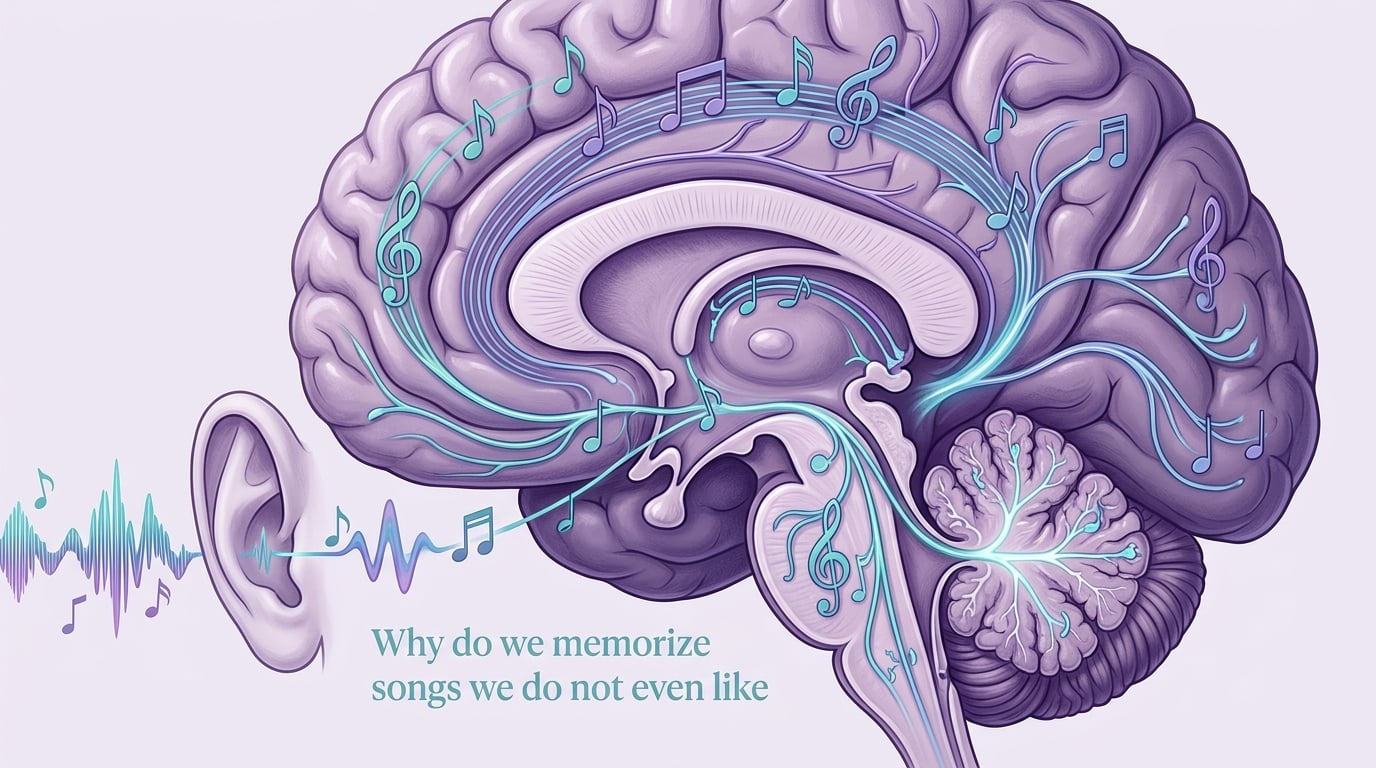
Why do we memorize songs we do not even like? Because the brain stores music through procedural memory — the same system that lets you ride a bike without thinking — combined with massive involuntary repetition (radio, ads, gyms, supermarkets) and emotional encoding that strengthens the memory on every listen. You do not choose to remember the song. The repetition chooses for you.
I have stood in grocery store aisles mouthing lyrics to songs I would never voluntarily play, and I am not alone. Across Reddit threads in r/NoStupidQuestions and r/explainlikeimfive, thousands of people describe the same strange asymmetry: they can recite an advert jingle from 2002 but forget why they walked into the kitchen. Our team dug into the music psychology research from Durham University, Bucknell, and Frontiers in Neuroscience to map exactly what is happening in the brain when an unwanted song becomes a permanent resident.
On this pageTable of Contents
- How does the brain memorize songs we don’t even like?
- Why music works as a memory machine
- Repetition and incidental exposure: how disliked songs get heard anyway
- The dopamine reward loop: why the brain encodes music even when we don’t enjoy it
- Earworms: when music plays on repeat inside your head
- The neuroscience: the musical memory area and the hippocampus
- When memory fails but music survives: dementia and Alzheimer’s
- Advertising jingles and meme songs: engineered memory hacks
- Can you un-memorize a song you don’t like?
- Frequently Asked Questions
- Why do humans remember music so well?
- Why is it easier to memorize songs?
- How many songs can a human brain memorize?
- Why do people with dementia remember songs?
- Why do people with ADHD listen to the same songs?
- What music is healthiest for the brain?
- Can you erase a song from your memory?
- The takeaway on why we memorize songs we do not even like
How does the brain memorize songs we don’t even like?
The short answer is that music uses a different memory system than the one you use to remember names, facts, or where you parked. That system is called procedural memory, and it sits alongside implicit memory in the brain’s deeper, older hardware.
Procedural memory is the kind of memory that works without effort. You do not consciously rehearse how to walk, type, or swim. Similarly, you do not consciously rehearse the chorus of a song you have heard thirty times. Your brain treats the song the way it treats a motor skill: it absorbs the pattern and plays it back on demand.
Dr. Kelly Jakubowski, a music psychology professor at Durham University, has spent her career studying this asymmetry. In her 2023 explainer for Durham’s Thought Leadership series, she frames song lyrics as occupying a “privileged place in memory” because they bypass the effortful encoding that ordinary learning demands. You are not studying the lyrics. The lyrics are studying you.
This procedural route is why a song you actively dislike can still surface word-for-word decades later. The brain does not file music under “enjoyed content” the way a streaming service does. It files music under “pattern completed, motor circuit engaged, dopamine released” — and that tag applies to your entry as easily as to a song you love.
Why music works as a memory machine
Music is a memory machine because it stacks four predictability cues at once: rhythm, melody, rhyme, and segmentation. Each cue turns lyrics into chunks the brain can swallow whole instead of memorizing word by word.
Rhythm gives the brain a beat to hang words on. Without a beat, “the rain in Spain stays mainly in the plain” is just eleven syllables. With a beat, it is one rhythmic gesture the motor cortex can store and replay. Melody adds pitch contour, which the auditory cortex tracks almost automatically. Rhyme and alliteration collapse similar sounds into predictable patterns, so the brain only has to store one cue and fill in the rest.
Jakubowski calls this a “predictable scaffold.” The scaffold does the heavy lifting; your conscious attention is optional. That is why kids learn the alphabet song before they learn the alphabet, and why you can still sing every word of a song you learned at age seven even if you have not heard it since.
Segmentation is the underappreciated fourth cue. Songs split lyrics into verses, choruses, and bridges that match the brain’s natural chunking limit. You are not memorizing a wall of text. You are memorizing four short walls, each with a familiar shape, separated by a beat drop or a melodic lift.
Repetition and incidental exposure: how disliked songs get heard anyway
Here is the angle none of the major competitors cover: the reason you memorize songs you do not even like is mostly because of incidental exposure. You hear them whether you want to or not.
Open any Spotify Wrapped infographic and you will see average listeners rack up 32 hours of music per week. But that figure counts the songs people choose. It misses the songs the world chooses for them: the radio in the Uber, the playlist bleeding from the gym’s speakers, the looped track in the supermarket, the hold music on a customer service call, and the jingle that plays before every YouTube ad.
Incidental exposure is invisible but powerful. Research summarized in Time’s coverage of music psychology points out that involuntary musical imagery — songs playing in your head — is usually seeded by music you heard passively, not music you played on purpose. The brain catalogs those fragments and replays them later, often without warning.
This is also why meme songs and advertising jingles stick. They are engineered for repeat exposure. A well-cut jingle hits in under seven seconds, repeats its hook three times, and gets aired thousands of times per day across every channel a brand owns. You did not choose to memorize it. The medium chose for you. Reddit users in r/LetsTalkMusic describe catching themselves humming 15-second TikTok audio loops months after they last heard them, with no memory of when the song originally entered their head.
The dopamine reward loop: why the brain encodes music even when we don’t enjoy it
Music triggers dopamine release in the brain’s reward centers whether or not you like the song as a whole. Studies using PET scans have measured dopamine increases of up to 9% in the striatum and caudate when listeners hear pleasurable music, but the same reward circuitry fires for familiar patterns even when the listener reports neutral or negative feelings about the track.
This is the emotional encoding effect. The amygdala, the brain’s emotion tagger, stamps music with a feeling label on the first few listens. After that, the dopamine system and the motor system keep reinforcing the song every time the chorus arrives. The brain is not asking your opinion. It is treating the song as a completed reward-prediction loop and filing it under “this happens, so this matters.”
Dr. Andrea Halpern of Bucknell University, one of the leading researchers on musical imagery, has shown that people can hold remarkably accurate mental images of songs they have not heard in years. Her work, cited in Time’s feature on the psychology of musical memory, found that listeners could reproduce the tempo of familiar songs within about 59% accuracy — meaning their internal representation of the song was nearly as stable as the recording itself. That fidelity exists regardless of whether the listener enjoys the music.
Earworms: when music plays on repeat inside your head
An earworm is the technical name for a song stuck in your head — scientists call it involuntary musical imagery, or INMI. About 90% of people report experiencing earworms at least once a week, and a small subset experience them almost daily.
Earworms tend to be songs with fast tempos, simple melodic contours, and unusual interval patterns. The brain loves a pattern with a small surprise. Pop hooks, nursery rhymes, and advertising jingles all fit that profile. Disliked songs fit it especially well, because the surprise element of an annoying or cheesy hook is exactly what keeps the pattern in working memory.
The completion tendency is the key mechanism. The brain hates an unresolved pattern. If you hear the first half of a chorus, your brain will keep replaying that half until the second half arrives — either from a real speaker or from your internal replay button. Disliked songs make great earworms precisely because they are familiar enough to start the loop and irritating enough that you do not want to finish it consciously, which paradoxically keeps the loop spinning longer.
The neuroscience: the musical memory area and the hippocampus
Two brain regions do most of the work when a song gets stuck. The first is the hippocampus, a seahorse-shaped structure deep in the temporal lobe that handles autobiographical and declarative memory. The second is a region called the musical memory area, or MMA — a network that includes the ventral pre-supplementary motor area and the caudal anterior cingulate gyrus, both in the frontal cortex.
The MMA is where the brain stores the motor and melodic pattern of a song, separate from the lyrics and separate from the moment you first heard it. Frontiers in Neuroscience published a landmark imaging study showing that the MMA lights up when listeners hear familiar music, even when other memory systems are failing.
The famous case of Clive Wearing makes this concrete. Wearing, a British musicologist, lost nearly all his memories to a viral brain infection in 1985. He could not remember what had happened five minutes earlier. But he could still sit at a piano and play elaborate pieces he had learned decades before, and he could still sing hymns from his childhood note-for-note. His procedural music memory survived while his declarative memory collapsed. Henry Molaison, the famous amnesiac “H.M.” studied from the 1950s onward, showed a similar pattern: surgery removed most of his hippocampus, wiping his ability to form new declarative memories, but he could still learn new songs through repetition.
When memory fails but music survives: dementia and Alzheimer’s
Music is among the last things to leave a person with dementia. Brain imaging studies have shown that the MMA and adjacent motor regions are among the last to accumulate the beta-amyloid plaques and tau tangles that characterize Alzheimer’s disease. By contrast, the hippocampus — the structure that handles most declarative memory — is damaged early.
This is why music therapy is one of the most reliable non-pharmaceutical interventions in dementia care. A patient who can no longer recognize their spouse can often still sing every word of a song from their wedding day. The Frontiers study put it bluntly: musical memory is the last thing we forget.
Practically, this means families and caregivers can use familiar music to reach relatives with advanced memory loss in ways that conversation cannot. Singing, humming, or simply playing a beloved track can calm agitation, restore a sense of self, and open a window into autobiographical memory that seems to have closed everywhere else.
Advertising jingles and meme songs: engineered memory hacks
If the brain treats songs as patterns to encode, then any song engineered around that pattern will stick on command. That is exactly what advertisers do. A good jingle is built to exploit chunking, repetition, rhyme, and the completion tendency in under seven seconds.
The same playbook now drives meme songs and viral audio on TikTok, Instagram Reels, and YouTube Shorts. The shortest path to ubiquity is a 15-second hook that repeats a single melodic phrase three or four times, posted by an influencer with reach, then seeded across feeds algorithmically. By the time you consciously register the audio, your procedural memory has already filed it.
Some researchers call this “engineered earworm.” It is the same underlying mechanism as a 1960s cereal jingle, just compressed into a vertical video and distributed at industrial scale.
Can you un-memorize a song you don’t like?
There is no off switch for a memorized song, but you can evict one. Cognitive psychologists who study INMI suggest a few practical moves.
Engage the completion tendency deliberately: finish the song out loud, even badly, so your brain gets the missing second half and stops looping. Replace the earworm with a different full song — researchers call this “song replacement,” and a competing complete loop usually wins. Chew gum or hum a different tune. Active tasks that engage the mouth and the motor cortex interfere with the inner playback loop. And avoid triggering cues. If the song is associated with a specific context (a gym, a coffee shop, a commute), changing the route or playlist for a few days can prevent the loop from re-seeding.
None of these erase the memory. The procedural trace is durable. But you can usually stop the song from playing on the inside, which is what most people actually want.
Frequently Asked Questions
Why do humans remember music so well?
Because music is stored in procedural memory, the same brain system that handles skills like riding a bike. It stacks four predictability cues at once — rhythm, melody, rhyme, and segmentation — so the brain encodes the song almost automatically, with very little conscious effort or rehearsal required.
Why is it easier to memorize songs?
Songs use rhythm, melody, and rhyme to chunk lyrics into patterns the brain can store as a single unit. Instead of memorizing dozens of words, the brain memorizes a handful of melodic phrases and fills in the rest from memory of the pattern.
How many songs can a human brain memorize?
Researchers estimate the average adult can carry around 1,000 to 2,000 songs in long-term memory, with frequent listeners reaching several thousand. The ceiling is not the storage itself but the lifetime hours of repetition and incidental exposure it takes to encode each new pattern.
Why do people with dementia remember songs?
Musical memory lives in the pre-supplementary motor area and related motor regions — areas that are among the last to deteriorate in Alzheimer’s disease. The hippocampus, which handles most declarative memory, is damaged much earlier. That is why patients who cannot recognize family can still sing childhood songs note-for-note.
Why do people with ADHD listen to the same songs?
Listeners with ADHD often report stronger-than-average lyric memory and more frequent earworms. Repetition helps the dopamine reward system lock in the song’s pattern, and familiar tracks provide predictable stimulation that supports attention. The same repetition that cements any song cements a favorite one faster.
What music is healthiest for the brain?
Research on music and cognition points to familiar, personally meaningful music as the most beneficial — particularly for mood, stress reduction, and memory recall in older adults. There is no single genre that wins on brain health; what matters is whether the music engages the listener’s autobiographical memory and reward system.
Can you erase a song from your memory?
Not really. Procedural memory traces for music are durable and cannot be deleted on demand. But you can usually stop a song from playing in your head by finishing it out loud, replacing it with a different full song, chewing something, or avoiding the cues that originally seeded the loop.
The takeaway on why we memorize songs we do not even like
So why do we memorize songs we do not even like? Three forces combine. First, music is stored in procedural memory, the brain’s automatic skill system, which encodes patterns whether or not we enjoy them. Second, dopamine and the amygdala stamp music with emotional weight on every listen, locking it in deeper than ordinary facts. Third, incidental exposure — radio, ads, gyms, supermarkets, viral audio — floods the brain with repetition we never consented to.
None of those forces require you to like the song. That is the strange generosity of the musical brain: it will memorize anything melodic, rhyming, and repeated, and it will hold it for decades. The same mechanism that frustrates you with a hated chorus is the one that lets a person with advanced dementia still sing their wedding song. Our team finds that humbling. The next time a song you cannot stand starts looping in your head, the brain is doing exactly what it was built to do. It just does not check with you first.