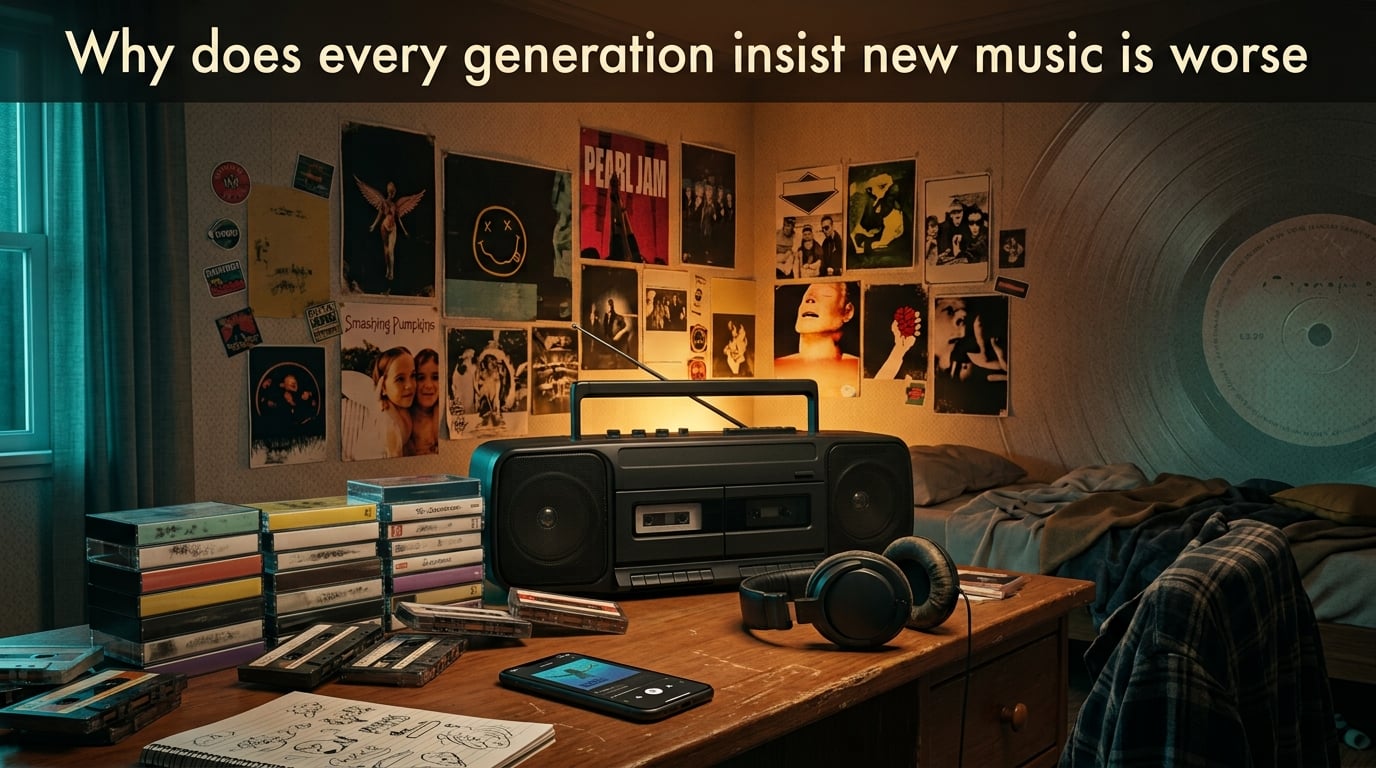
Every generation insists new music is worse. Your grandparents said it about the Beatles. Your parents said it about rap and grunge. You have probably said it about whatever is on the radio right now. The complaint is so predictable, so universal, that it almost feels choreographed — and that is the first clue that something deeper than taste is going on.
I have spent the last few months digging into the psychology, neuroscience, and cultural history behind this pattern, and what I found surprised me. The music really is not getting worse. Your brain is just doing what brains do. Below is the honest, science-backed answer to why every generation insists new music is worse — and what to do about it if you want to stay curious about new music as you age.
The short answer: musical taste hardens in our early twenties because of the mere exposure effect, the emotional intensity of adolescence, and a neuroscience phenomenon called the reminiscence bump. Familiar music feels deeper, and unfamiliar music feels shallower — every single time. It is not a flaw in the music. It is how your memory works.
On this pageTable of Contents
- Is Today’s Music Actually Worse, or Are We Just Not Teenagers Anymore?
- When Musical Taste Locks In: The 13 to 33 Window
- The Mere Exposure Effect: Why Familiar Always Wins
- The Reminiscence Bump: The Neuroscience of Why Your Teen Soundtrack Feels Eternal
- Why Popular Music Is Built for Teenagers, Not Adults
- A Decade-by-Decade Look at Generational Music Rifts
- The Gen Z Reversal: Why Younger Listeners Are Returning to Older Music
- Modern Amplifiers: How Streaming, Social Media, and the Internet Deepen the Pattern
- The Openness-to-Experience Connection: Who Stays Curious About New Music
- How to Stay Open to New Music as You Get Older
- Frequently Asked Questions
- Why is new music worse?
- At what age do people stop liking new music?
- Why is Gen Z listening to old music?
- What is Gen Z’s favorite music genre?
- The Real Reason Every Generation Insists New Music Is Worse
Is Today’s Music Actually Worse, or Are We Just Not Teenagers Anymore?
The honest answer is: we are mostly just not teenagers anymore. Studies and listener data going back decades keep finding the same thing — each cohort thinks its own era produced the greatest music, then discounts everything after. In 2026, the pattern is no different. Boomers prefer seventies rock, Millennials and Gen X prefer nineties music, and only Gen Z still leans toward current releases. That is not a verdict on quality. That is a snapshot of where each generation’s memory froze.
Yes, there is plenty of formulaic and corporate-sounding music on the charts in any era, including now. But there is also plenty of it in every previous decade, once you strip away the nostalgia filter. The post on r/popheads that inspired half the internet to argue about this got it right — older listeners are not rejecting current music because it is worse. They are rejecting it because it does not feel like the songs that soundtracked their own coming-of-age.
When Musical Taste Locks In: The 13 to 33 Window
Musical taste begins to crystallize around age 13 or 14 and is largely locked in by the early twenties. That window — roughly ages 13 to 33 — is when we form the strongest emotional memories, when our sense of identity takes shape, and when we listen to more new music per week than we ever will again. By the time most people hit their mid-thirties, exploration drops sharply. The songs we bonded with during that window become the reference point against which every unfamiliar new song is judged.
This is why your favorite album of all time probably came out when you were 15. It is also why a 50-year-old and a 20-year-old can sit in the same room, listen to the same song, and have completely different emotional reactions to it. The older listener is not hearing the same song. They are hearing it through thirty-plus years of memory layered on top.
A useful rule of thumb: if a song came out before you were 13 or after you turned 30, it will probably never feel as deep as the songs from that stretch in between. That is not a verdict on the song. That is just how autobiographical memory is wired.
The Mere Exposure Effect: Why Familiar Always Wins
The mere exposure effect is the psychological phenomenon where repeated exposure to any stimulus — a sound, a face, a melody — increases our preference for it. We do not consciously decide to like familiar things. Our brains do it for us, automatically, every time we hear a song more than once.
This is the single most important mechanism behind the generational music pattern. By the time you reach your mid-thirties, you have heard the songs from your teen years hundreds, often thousands of times — on the radio, in movies, in supermarkets, on hold music, in the background of every party you have ever been to. The new song has been heard once, maybe twice. They are not even competing on a level playing field.
Music psychologist Daniel Levitin, author of This Is Your Brain on Music, points out that preference and familiarity are almost the same thing in the brain. The reward circuitry that fires when we hear a beloved old song is the same circuitry that gets trained by repetition. New music has to overcome decades of neurological head start just to get to neutral.
The Reminiscence Bump: The Neuroscience of Why Your Teen Soundtrack Feels Eternal
There is a specific neuroscience concept that explains why your high school soundtrack feels more vivid than anything released since, and almost no one writing about this pattern ever mentions it: the reminiscence bump. It is the well-documented finding that, once we pass about age 40, our autobiographical memories cluster disproportionately around our late teens and early twenties. Songs from that period feel more emotionally saturated, more meaningful, more true, even decades later.
Cognitive scientists trace this back to a combination of brain development and identity formation. The late-teens and early-twenties years are when the prefrontal cortex is still maturing, when first relationships, first heartbreaks, first independence, and first self-definition all happen at once. The brain tags those memories with extra emotional salience — and the music playing in the background gets tied up in the tag. The song is not the memory. The song is the memory’s sound.
This is also why, for most people, the music of their twenties feels more emotionally loaded than the music of any other decade. It is not because the music was better. It is because the brain was a different brain back then, more porous, more hungry, more willing to fall in love with a chorus on first listen.
Why Popular Music Is Built for Teenagers, Not Adults
There is a second half of the explanation that is not about listeners at all — it is about the music itself. Popular music is, structurally and thematically, written for people in the middle of identity formation. Lyrics are about rebellion, first love, defiance, alienation, and figuring out who you are. Sonics are louder, faster, and more hook-driven than anything written for an older audience. Pop hits are designed to be discovered for the first time in the back seat of a car, not in a quiet living room at age 47.
This is not a new problem. In 2026, the same complaint is being made about post-2020 pop that was made about disco in 1977, hair metal in 1987, and grunge in 1993. The Saturday Evening Post ran an article in 1967 — headlined Pop Music: The Most? Or Just a Mess? — making the exact same argument about The Supremes. The names change. The complaint does not.
When we age out of that target audience, we are not just losing taste. We are losing the demographic the music was made for. Of course it feels less like it belongs to us. It was never meant to.
A Decade-by-Decade Look at Generational Music Rifts
The pattern has been repeating, with eerie consistency, since the birth of rock and roll. A compact timeline makes the symmetry obvious.
- 1950s: White parents panic over Elvis and rock and roll. Bobby-soxers who screamed for Frank Sinatra in the 1940s are now the parents clutching their pearls at the new sound.
- 1960s: The Beatles, the Stones, and psychedelia terrify a generation that grew up on Perry Como. The Saturday Evening Post publishes its first major “pop music is in decline” essay.
- 1970s: Disco, glam, and the beginnings of hip-hop fragment the audience. Parents cannot agree on what to hate because there are now too many targets.
- 1980s: MTV launches in 1981. Music becomes visual. Parents complain about synthesizers, hair metal, and the new dominance of the image over the song.
- 1990s: Grunge, gangsta rap, and alternative rock trigger a fresh round of moral panic. Tipper Gore’s PMRC, congressional hearings, and parental advisory stickers follow.
- 2000s: File-sharing and the early internet democratize access. Older listeners complain that music has lost its shared, communal quality.
- 2010s: Streaming takes over. Playlist inertia replaces radio. Older listeners feel increasingly locked out of the conversation.
- 2020s: TikTok-driven hits, genre fragmentation, and the Gen Z return to older eras. The complaint cycle continues — but now with new wrinkles.
Every decade on that list had parents insisting the music was getting worse. Every decade, the music kept getting made anyway. And every generation eventually decided the music of its own teens was the real music, and everything else was noise.
The Gen Z Reversal: Why Younger Listeners Are Returning to Older Music
There is one twist in the 2026 story that did not exist a generation ago: Gen Z is breaking the pattern. According to Luminate’s 2022 data, Gen Z is the only current generation whose listening preferences still lean toward current releases — but the share of Gen Z listeners returning to music from the sixties, seventies, eighties, and nineties has grown sharply. Twenty-something listeners are streaming Fleetwood Mac, Nirvana, and the same Sinatra records their grandparents played.
Two things are driving it. First, the internet flattened the music catalog. A teenager in Ohio can hear the same obscure 1971 soul cut a teenager in Tokyo can, in seconds. When access is unlimited, nostalgia is no longer a generational privilege — it is a search bar. Second, TikTok and YouTube keep resurfacing older tracks in new contexts, giving them a second adolescence with an entirely new audience. A song does not need a new release date to feel like a discovery.
This is also why Gen Z’s favorite music genres, in surveys, now include a heavy dose of older rock, classic country, and even pre-2010 pop alongside the contemporary stuff. They are not rejecting new music — they are simply the first generation that does not have to choose between eras.
Modern Amplifiers: How Streaming, Social Media, and the Internet Deepen the Pattern
If the psychological mechanism behind this pattern is old, the modern amplifiers are new — and they make it stronger. Three forces in particular are doing the work.
Streaming playlists create inertia. Spotify’s algorithmic playlists are tuned to reinforce what you already like. Every listen trains the next recommendation. The longer you use them, the narrower the listening window becomes. Streaming rewards the same songs on repeat, which deepens the familiarity effect that already favors older music.
Catalog acquisition locks older music in further. In recent years, private equity and venture capital funds have spent billions buying up music catalogs — Bob Dylan, Bruce Springsteen, Sting, the Red Hot Chili Peppers, the entire catalog of the Stones. When investors want those songs to keep earning, they get placed in ads (Geico, TurboTax, Yoplait, Fiber One all ran major campaigns on classic rock tracks in the last few years), re-released as anniversary editions, and pushed onto the same streaming playlists that listeners already trust. New artists get squeezed out of the oxygen.
Internet nostalgia loops. Facebook memories, Instagram reels, YouTube concert footage, and TikTok edits keep re-exposing older listeners to the music of their youth, on repeat, every week. The mechanism is the same as the mere exposure effect — only the delivery system is faster. By the time a 55-year-old hears “Don’t Stop Believin'” again on a Tuesday, they have heard it thousands of times across their lifetime. A new song by a new artist has no chance.
The chart data tells the same story. Journey’s Greatest Hits has now spent more than 828 weeks on the Billboard 200 — longer than almost any studio album in history. Catalog music is not just surviving. It is crowding out new releases on the very charts meant to track new music.
The Openness-to-Experience Connection: Who Stays Curious About New Music
Personality research offers an interesting twist on all of this. In the Big Five model of personality traits, openness to experience is the trait most strongly linked to curiosity, novelty-seeking, and willingness to engage with unfamiliar art. People high in openness keep exploring new music well into their fifties and sixties. People low in openness tend to lock in earlier and stop.
This is not a moral judgment. It is a measurable personality difference that maps almost perfectly onto how aggressively someone will resist the latest trend. The same pattern shows up in food, fashion, travel, and even movie taste. Some people are wired to keep sampling. Some people are wired to settle in. Both are perfectly fine.
The useful framing here is that resistance to new music is not a sign of being closed-minded in general. It is a sign that your brain has built a soundtrack that already works for you. New music has to climb a wall of neural habit to compete.
How to Stay Open to New Music as You Get Older
None of this is destiny. Listeners who keep finding new music they love into their forties, fifties, and beyond tend to do a few things in common. None of these are magic. They are just habits that push back against the gravitational pull of the familiar.
- Build a discovery routine. Set aside 20 minutes a week to listen to one new release or playlist you did not choose yourself. Algorithmic “Discover Weekly” and friends’ shared playlists work because they short-circuit habit.
- See live music more. A live show activates emotional memory in a way recorded music cannot. The brain tags the experience differently, which makes the song easier to bond with later.
- Borrow a teenager. Ask a younger friend, sibling, or coworker what they are listening to right now. Listen to the whole album, not just the singles. Most of it will not stick. Some of it will.
- Cross genres instead of doubling down. If you love classic rock, try a current jazz or electronic release instead of another new rock band. The familiar genre deepens the old habit. The unfamiliar genre can break it.
- Forgive your own resistance. It is not a failure of taste. It is how memory works. Letting go of the guilt makes it easier to stay curious.
The pattern is not going to break for any of us individually. The brain wants what the brain already knows. But curiosity is a habit, and habits respond to a little nudging.
Frequently Asked Questions
Why is new music worse?
New music is not actually worse — every generation believes the music of its own era is the best, and every subsequent generation inherits the same complaint. The sense that current music sounds worse is driven by the mere exposure effect, the emotional intensity of the teen years, and the neuroscience of the reminiscence bump. Familiar songs from ages 13 to 30 feel deeper than unfamiliar ones, regardless of the unfamiliar song’s actual quality.
At what age do people stop liking new music?
Musical taste begins to crystallize around age 13 or 14 and is largely locked in by the early twenties. Most people stop actively exploring new music somewhere in their late twenties to early thirties, though personality traits like openness to experience can extend that window. By the mid-thirties, the music of someone’s teen years has become the reference point against which every new song is compared.
Why is Gen Z listening to old music?
Gen Z is the first generation with unlimited, equal access to the entire history of recorded music. Streaming flattened the catalog, and TikTok and YouTube keep resurfacing older tracks for new audiences. Surveys show Gen Z still leans toward current releases more than older cohorts do, but they also stream more older music than any previous young generation did.
What is Gen Z’s favorite music genre?
Gen Z’s listening is more genre-fluid than any previous generation. Surveys show strong preferences for hip-hop, pop, Ru0026amp;B, indie, and older rock and classic country. There is no one dominant genre — instead, listeners mix current hits with music from earlier decades in a way previous generations, locked into fewer formats, never could.
The Real Reason Every Generation Insists New Music Is Worse
Every generation insists new music is worse for the same reason: by the time we are old enough to notice the music changing, our brains have already chosen the soundtrack of our own youth. The mere exposure effect, the emotional intensity of adolescence, the reminiscence bump, and the personality trait of openness to experience all push in the same direction. None of it is about the new music being bad. It is about the old music being unforgettable, for reasons that have nothing to do with sound quality and everything to do with when you first heard it.
The reassuring part is that the pattern is universal. Your parents were not reacting to your music any differently than their parents reacted to theirs, or than you will eventually react to your kids’. Knowing this does not stop it from happening. It just removes the guilt. If you want to stay curious, the path is small, repeatable, and worth the effort. If you do not, that is also fine. The music will keep getting made. A future teenager is going to fall in love with whatever is on the radio right now, and one day they will write an essay about how nobody makes music like that anymore.