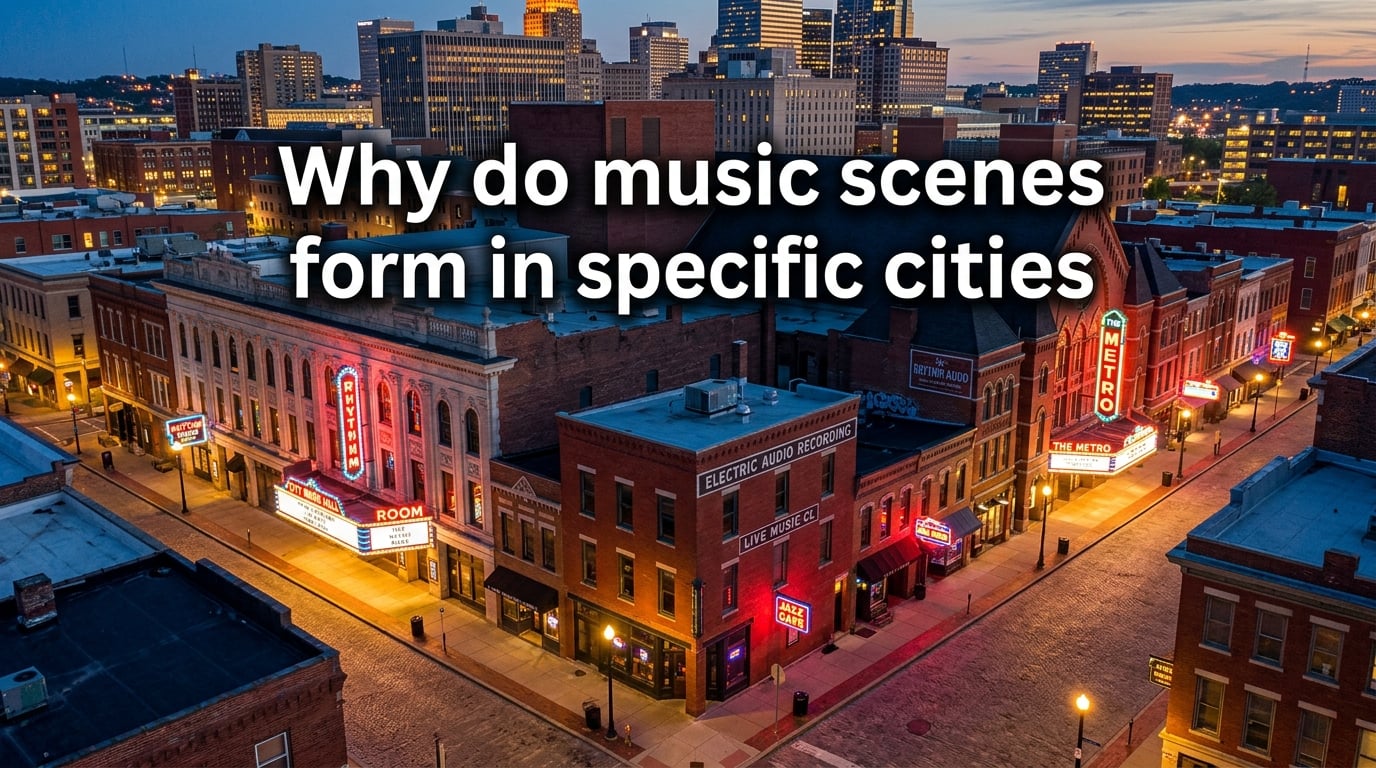
A music scene is the locally rooted ecosystem of musicians, venues, audiences, promoters, studios, and institutions that create, perform, and sustain a distinctive sound, usually in one city or neighborhood. Scenes form in specific cities because those places stack the right ingredients together: an affordable, walkable urban core, multiple-sized venues, a steady talent pipeline, loyal audiences, and tight word-of-mouth networks. In this guide, I walk through the six drivers that explain why music scenes form in specific cities, the case studies that prove the pattern, and the forces that cause scenes to fade.
I’ve spent years writing about local music ecosystems, and the pattern is striking. Athens, Georgia is a town of roughly 130,000 people that birthed the B-52s and R.E.M. Memphis produced Elvis, Sun Studio, and Stax. Liverpool, an industrial port city, gave us the Beatles. Geography, economics, and culture conspired in each case. Below, I unpack exactly how that conspiracy works.
On this pageTable of Contents
- What Is a Music Scene and Why Do Cities Get One?
- The 6 Drivers That Make a Music Scene Form
- Geography and Place: How Location Shapes a Scene
- Infrastructure: Venues, Studios, Labels, and the Spaces Between
- Economic Foundations: Cost of Living, Industry Hubs, and the Rent Trap
- Culture, Migration, and the Social Networks Behind the Sound
- Why College Towns Punch Above Their Weight
- 7 Iconic Music Cities and the Scenes That Built Them
- Nashville: The Industry Hub
- Detroit: Motown, Techno, and the Great Migration
- Seattle: Grunge and the Isolation Premium
- Memphis: The Blues and Soul Crucible
- New Orleans: The Oldest Living Scene
- Liverpool: A Port City That Gave the World the Beatles
- Athens, Georgia: The College Town That Invented Alt-Rock
- Digital Age: Why Geography Still Matters When Music Is Everywhere
- Why Some Music Scenes Fade
- Can a City Deliberately Build a Music Economy?
- Frequently Asked Questions
- What defines a music scene?
- Which US cities have the best music scene?
- What city is known as the heart of country music?
- Is a music scene a subculture?
- What city is known for Music City?
- What city is considered a Music City?
- How does music build communities?
- How does a city develop a live music scene?
- Why Do Music Scenes Form in Specific Cities: A Final Take
What Is a Music Scene and Why Do Cities Get One?
A music scene is more than a list of bands. Researchers Richard Florida and Kara Jackson describe it as “a geographically delimited market in a microcosm.” In plain terms, it’s the local system that produces, performs, records, and distributes music with its own flavor, supported by the people who show up, book the gigs, and write the checks.
A music city is the broader frame: a place recognized for its music, whether that means a single dominant genre (Nashville and country) or a long-running creative pipeline (Detroit and Motown, then techno, then garage rock). The Music Cities Network, working with organizations like Music Canada, scores cities on several pillars: live music venues per capita, recording studios, festival activity, music tourism, and the strength of the local industry.
The question of why do music scenes form in specific cities is not really about a single cause. It is about a stack of conditions that cluster in some places and not others. The rest of this article breaks that stack into its parts.
The 6 Drivers That Make a Music Scene Form
When I map the academic literature, the Reddit threads, and the case studies side by side, six drivers appear again and again. Every famous scene is a combination of these. None of them alone is enough.
- Geography and place – location, isolation, transit routes, and how bands physically move through a city.
- Economic foundations – cost of living, day-job economies, music tourism revenue, and the rent trap.
- Culture and demographics – heritage, migration, subcultures, and a city’s sense of itself.
- Infrastructure – venues, recording studios, record labels, rehearsal rooms, record stores.
- Social networks – booking agents, promoters, critics, fans, and the regulars who hold it all together.
- Institutions – schools, conservatories, music offices, halls of fame, and the institutions that anchor a scene long-term.
The drivers reinforce each other. A college (institution) feeds a talent pipeline (social network) that fills venues (infrastructure) in a walkable downtown (geography) where rent is still affordable (economics). When one piece breaks, the whole stack can wobble.
| City | Geography | Economy | Culture | Infrastructure | Networks | Institutions | Iconic Genre |
|---|---|---|---|---|---|---|---|
| Nashville, TN | River crossroads, central US | Industry hub, music tourism | Country, gospel, Americana roots | Music Row, many studios | Labels, publishers, songwriters | Grand Ole Opry, CMA, BMI | Country |
| Detroit, MI | Rust Belt, Great Lakes | Auto union day-job economy | Black migration, Motown culture | Hitsville U.S.A., labels | Hitsville assembly line | Motown Museum | Motown, techno |
| Seattle, WA | Pacific NW isolation | Affordable rent in 1980s | Pacific NW subculture | Sub Pop, studios, clubs | Tight local scene, fanzines | Experience Music Project | Grunge |
| Athens, GA | Small college town | Low cost of living | UGA art-school subculture | 40 Watt Club, studios | Local bands backing locals | University of Georgia | Indie rock |
| Liverpool, UK | Port city, Atlantic trade | Working-class day jobs | Merseyside Irish roots | Cavern Club, labels | Mersey Beat scene | Liverpool Institute for Performing Arts | Merseybeat, Britpop |
| New Orleans, LA | Port and river delta | Tourism economy | Congo Square, Creole culture | Preservation Hall, studios | Brass bands, second lines | Jazz Museum, UNO jazz program | Jazz |
| Memphis, TN | Mississippi River hub | Working-class music jobs | Blues, gospel, rockabilly | Sun Studio, Stax | Blues scene, Beale Street | Rock and Soul Museum | Rock and roll, soul |
Geography and Place: How Location Shapes a Scene
Geography is the first constraint. A city has to be where musicians can physically gather, where audiences can show up, and where touring bands can route through without losing money.
Touring bands work the geography of interstate highways and short drives between cities. A scene like Seattle in the late 1980s benefited from being far enough from Los Angeles to be ignored, but connected enough that Sub Pop could route grunge bands through the Pacific Northwest circuit. Athens, Georgia is two hours from Atlanta, on a corridor that touring bands already used. Detroit sits where the Great Lakes and the auto industry intersect, drawing workers and artists from across the South and Midwest.
Port cities produce scenes because they have always been cosmopolitan, full of sailors, migrants, and travelers. Liverpool is the classic case: a working-class port whose Atlantic trade links and Irish population fed the Mersey Beat sound. New Orleans is another port city, and jazz is unthinkable without Congo Square, the French Quarter, and the constant flow of people in and out.
Geographic isolation can be a feature, not a bug. Bands in isolated towns build their own thing because they cannot copy what’s “in” elsewhere. That is part of why Athens and Olympia, Washington developed such distinct sounds.
Infrastructure: Venues, Studios, Labels, and the Spaces Between
Once a city has the geography, it needs the physical plant. Venues are the obvious piece. A scene needs a range: small clubs (capacity 50-150) where new bands cut teeth, mid-sized rooms (300-800) where local openers share bills with touring acts, and larger halls for festival-style nights. When a city loses its mid-sized venues, the scene loses its middle class of musicians.
Recording studios are the second piece. Hitsville U.S.A. in Detroit, Sun Studio in Memphis, Stax in Memphis, Ardent in Memphis, Electrical Audio in Chicago, and countless studios in Nashville’s Music Row turned local performances into records that traveled. Studios also employ engineers, producers, and session musicians, which means day jobs that let artists stay in the city.
Labels and publishers concentrate in industry hubs. Nashville’s Music Row, Los Angeles’s Sunset Strip, and New York’s Tin Pan Alley all started as physical districts where songwriters, publishers, and labels could walk to each other’s offices. Record stores in those same districts – Grimey’s in Nashville, Third Man in Detroit, Easy Street in Seattle – served as informal gathering spots where fans learned what to listen to next.
Rehearsal spaces round out the infrastructure. In an affordable city, a band can rent a warehouse room for a few hundred dollars a month. In an unaffordable city, that same room costs more than a band can pay, and rehearsal moves to a garage or stops entirely.
Economic Foundations: Cost of Living, Industry Hubs, and the Rent Trap
The economic story has two sides. First, scenes need an economy that lets musicians survive between gigs. Second, scenes need a music economy that pays some musicians full-time.
David Byrne, writing about why scenes die, put it bluntly: “Rent must be low and must stay low.” Athens in 1978, Seattle in 1986, and Brooklyn in 2000 all had rents low enough that musicians could work part-time and still afford to play. When those cities got hot, the rents rose, and the musicians left. We are watching this exact cycle in Nashville right now, with songwriters priced out of East Nashville and moving to smaller towns in Tennessee and Kentucky.
Industry hubs are different. Nashville and Los Angeles are not cheap cities, but they have a thick layer of music-industry day jobs – publishing, sync licensing, session work, A&R – that pay real wages. A songwriter can write for a publishing house by day and play at the 5 Spot by night. A scene like Memphis in the 1950s had Beale Street’s economy of clubs, bars, hotels, and recording studios, all feeding each other.
Music tourism is the third economic pillar. Austin’s live music industry generates roughly 116,000 jobs and over a billion dollars in economic activity. Melbourne, Australia’s live music sector produces around AU$1 billion in spending and tens of thousands of jobs. Nashville’s music tourism brings more visitors than the city can count. When a city realizes that music is an export industry, it starts investing in it like one.
Culture, Migration, and the Social Networks Behind the Sound
Culture is the part that resists quantification, but it is also where scenes come alive. The Great Migration of Black Americans from the rural South to Northern cities like Detroit, Chicago, and New York brought blues, gospel, and jazz traditions that fed Motown, Chess Records, and a hundred other scenes. Houston’s hip-hop scene owes a debt to the Vietnamese, Mexican, and African American communities that settled the city.
Diaspora communities are creative forces almost everywhere. London’s Caribbean community shaped jungle, grime, and dub. Toronto’s immigrant neighborhoods built a pop and R&B pipeline. Montreal’s Haitian and North African communities fed its jazz and electronic scenes. Los Angeles’s Mexican American neighborhoods produced a regional Mexican music industry that is now the largest in the Spanish-speaking world.
Within any scene, the social network is the load-bearing wall. Booking agents decide who plays which room. Promoters pick the bills. Critics and zine writers tell fans what is good. Regulars – what No Depression’s writers call “mainstays” – show up three or four nights a week and support the same bands. When those networks tighten, the scene is robust. When they fray, the scene is fragile.
A live scene also depends on a specific kind of audience: one that listens to the opening act, that does not talk through the set, that comes back next week. That kind of audience is partly cultural and partly economic. It is the kind of audience you build when a city has long-running venues, local press, and a habit of paying attention.
Why College Towns Punch Above Their Weight
Look at the list of famous music cities that are not major metros and a pattern emerges: Athens, Georgia; Lawrence, Kansas; Denton, Texas; Charlottesville, Virginia; Champaign-Urbana, Illinois; Olympia, Washington; Ithaca, New York. These are college towns, and they have produced a wildly disproportionate share of famous bands.
The reason is the talent pipeline. A large university brings thousands of 18-22 year-olds together, many of them musicians or aspiring musicians. They form bands. They play house parties and dorms and small clubs. They graduate or they don’t, and the ones who don’t often stay because the cost of living is still low. Athens is a textbook case: the University of Georgia art students who formed the B-52s in 1977 were still in town partly because they could afford to be.
Universities also bring institutions: music programs, performance spaces, and a culture of listening. Berklee College of Music in Boston feeds the Boston scene. The Liverpool Institute for Performing Arts, founded in 1996 in the building Paul McCartney attended as a child, is a deliberate effort to recreate that pipeline.
Reddit threads on r/indieheads and r/LetsTalkMusic consistently name college towns as sleeper scenes. Charlottesville and Lawrence are repeatedly cited as underrated, not because their scenes are famous but because the bands that come out of them are unusually good for cities that size.
7 Iconic Music Cities and the Scenes That Built Them
The case studies below are condensed examples of the six drivers in action. Each one shows a different mix of geography, economics, culture, infrastructure, networks, and institutions.
Nashville: The Industry Hub
Nashville is the case where institutions and infrastructure dominate. The Grand Ole Opry, broadcasting on WSM since 1925, gave country music a national stage. Music Row, the publishing and label district that emerged in the 1950s, gave songwriters day jobs. The Country Music Hall of Fame, the Country Music Association, and BMI’s Nashville office all anchored the city.
Geographically, Nashville sits at the intersection of major interstates, central to the touring routes that connect the eastern US. Economically, the music industry supports tens of thousands of jobs. Culturally, the city’s gospel, country, and blues traditions were already in place when the industry formalized them.
Detroit: Motown, Techno, and the Great Migration
Detroit’s music scene is built on migration and industry. The Great Migration brought Black Southerners north to work in the auto plants, and they brought their music with them. Berry Gordy’s Hitsville U.S.A. applied Detroit’s assembly-line culture to songwriting and recording, producing a hit-making machine that defined the 1960s.
Later, the emptied houses and cheap rent of 1980s Detroit fed the techno scene, with producers like Derrick May and Juan Atkins building a new electronic sound in the city’s abandoned warehouses. The geography of the Great Lakes and the rust-belt economy shaped both phases.
Seattle: Grunge and the Isolation Premium
Seattle was geographically isolated, economically affordable, and culturally skeptical of the music industry. That combination, plus an independent label in Sub Pop and a fanzine culture, produced grunge. The scene blew up between 1988 and 1994 with Nirvana, Pearl Jam, Soundgarden, and Alice in Chains.
When the music industry rushed in, rents rose and the scene fragmented. Many of the original bands moved away. Seattle is a reminder that scenes can be fragile even at their peak.
Memphis: The Blues and Soul Crucible
Memphis sits on the Mississippi River, at the crossroads of Southern, Midwestern, and Delta musical traditions. Beale Street was a Black entertainment district from the late 1800s. Sun Studio, opened by Sam Phillips in 1950, recorded Elvis Presley, Johnny Cash, and Jerry Lee Lewis. Stax Records, founded in a former theater in 1957, recorded Otis Redding, Booker T. & the M.G.’s, and Isaac Hayes.
The infrastructure of studios, labels, and clubs made Memphis a recording hub. The cultural mix of blues, gospel, and country fed the rock and roll explosion.
New Orleans: The Oldest Living Scene
New Orleans is the oldest continuously active music city in the United States. Congo Square, where enslaved and free people of color gathered to play music on Sundays, is where jazz, in some sense, was born. The city’s port culture, French and Spanish colonial history, and Creole population all fed the sound.
The infrastructure is unusual because it is also a tourism economy. Preservation Hall, the Spotted Cat, and Tipitina’s are music venues that double as cultural institutions. The city rebuilds its scene after disasters – Hurricane Katrina devastated it in 2005 – and the scene rebuilds the city.
Liverpool: A Port City That Gave the World the Beatles
Liverpool is a working-class port city that, in the late 1950s and 1960s, produced more hit bands per capita than almost any city in history. The Cavern Club, a basement venue where the Beatles played nearly 300 times, was the venue infrastructure. The Mersey Beat newspaper was the social network. The city’s Irish population and Atlantic trade routes were the cultural and geographic foundations.
Today, Liverpool is still a music city. The Liverpool Institute for Performing Arts, founded in Paul McCartney’s old school building, is the institution. The city runs an annual Mathew Street Music Festival that draws hundreds of thousands.
Athens, Georgia: The College Town That Invented Alt-Rock
Athens is the smallest city on this list, and arguably the most concentrated music scene. In 1977, the B-52s formed at a friend’s house. In 1978, the 40 Watt Club opened. In 1980, R.E.M. played their first show. Throughout the 1980s, Athens bands packed 40 Watt, played house parties, and recorded at local studios like Chase Park Transduction.
The drivers are textbook. Low cost of living (economics). The University of Georgia art school (institutions and pipeline). A handful of venues and studios (infrastructure). Musicians supporting each other (social networks). A sense of place that resisted copying New York or LA (culture).
Digital Age: Why Geography Still Matters When Music Is Everywhere
Streaming and social media have changed the answer to why music scenes form in specific cities, but they have not erased it. A band can post a song to TikTok and reach a million listeners without leaving their hometown. Spotify’s algorithmic playlists can surface a regional sound to a global audience.
What the digital age has changed is the speed at which a scene can scale. Sub Pop could ship a Nirvana single and rely on college radio to break it; in 2026, a Bandcamp Friday can move a small-town band’s album in a day. What has not changed is the live scene. People still go to concerts in physical rooms, and those rooms are still concentrated in cities. Working musicians still need day jobs, rehearsal rooms, and venues they can reach on foot.
Reddit’s r/LetsTalkMusic has a recurring thread: “Do local scenes still exist?” The consensus is that scenes exist, but they are under pressure from venue consolidation, rising rents, and algorithmic music discovery. Geography still matters, but it is harder to build a scene in a city where the mid-sized venues have been replaced by chain restaurants.
Why Some Music Scenes Fade
Most articles on music scenes explain why they form. Few explain why they end. The mechanisms are mostly the reverse of the six drivers.
Gentrification is the most cited. When a neighborhood becomes fashionable, rents rise, musicians move out, and the venues that hosted them close. Brooklyn’s Williamsburg in the 2000s and East Nashville in the 2010s are textbook examples. Silver Lake in Los Angeles saw the same cycle earlier.
Consolidation of the live music industry is the second mechanism. National venue chains and ticketing platforms have squeezed out locally owned rooms. When a city’s venues are programmed by corporate bookers who book only touring acts, local openers lose the rung of the ladder where they learned to play for a crowd.
Demographic shifts matter too. Detroit’s white-flight depopulation in the 1970s and 1980s changed the city’s scene. Memphis’s economic decline hollowed out Beale Street’s club scene for decades. A scene is, in part, a demographic phenomenon, and demographic change reshapes it.
Can a City Deliberately Build a Music Economy?
Yes, with caveats. Music Canada, a division of the Canadian Music Publishers Association, has worked with cities across North America on a “music city” framework. The pillars are familiar from this article: live music venues, recording infrastructure, music tourism, industry jobs, education, and a city music office that coordinates policy.
Austin is the most-cited American example of deliberate scene-building. The city has a live music venue licensing program, a music commission, and decades of public investment in festivals like SXSW and Austin City Limits. Nashville’s music office and music advisory board do similar work. Liverpool’s Mathew Street festival and music office are a deliberate effort to maintain the city’s Beatles legacy.
Deliberate scene-building works when it amplifies existing drivers rather than inventing them from scratch. A city with no musicians, no venues, and no audience will not become a music city because it hired a consultant. A city with those ingredients but no coordination can grow much faster when it treats music as infrastructure, the way it treats roads and water.
Frequently Asked Questions
What defines a music scene?
A music scene is the locally rooted ecosystem of musicians, venues, audiences, promoters, studios, and institutions that create, perform, and sustain a distinctive sound, usually in one city or neighborhood. Researchers Richard Florida and Kara Jackson describe it as a geographically delimited market in a microcosm. The defining feature is that the ecosystem is local, dense, and self-reinforcing.
Which US cities have the best music scene?
There is no single answer, but cities that consistently rank at the top include Nashville (country, Americana), New York City (every genre), Los Angeles (pop, hip-hop, indie), Austin (live music capital of the world), Detroit (Motown and techno), Chicago (blues, jazz, indie), Memphis (blues, soul, rock), Seattle (grunge, indie), New Orleans (jazz, brass), and Athens, Georgia (indie rock). The right answer depends on the genre you care about and what kind of scene you want to be part of.
What city is known as the heart of country music?
Nashville, Tennessee is widely known as the heart of country music. The Grand Ole Opry has broadcast from Nashville since 1925, Music Row has been the center of country songwriting and publishing since the 1950s, and the Country Music Hall of Fame anchors the city’s identity. Nashville has officially branded itself Music City USA for decades.
Is a music scene a subculture?
Yes, in the sociological sense. A music scene is a music-based subculture: a group of people bound together by shared musical tastes, venues, communication channels (fanzines, group chats, label rosters), and identity markers like clothing and vocabulary. The subculture framing helps explain why scenes can be tight-knit even when the music itself is not commercially successful.
What city is known for Music City?
Nashville, Tennessee is the city most often called Music City. The nickname dates to the 1800s and was reinforced when the city embraced the brand in the twentieth century. Other cities sometimes called Music City include Austin (Live Music Capital of the World), Memphis (Home of the Blues, Birthplace of Rock and Roll), and Detroit (Motown).
What city is considered a Music City?
Any city with the six drivers in place can be considered a music city: a critical mass of venues, recording studios, labels, music-industry jobs, loyal audiences, and supportive institutions. The Music Cities Network scores cities against this framework. By that standard, recognized music cities include Nashville, Austin, Berlin, London, Melbourne, Tokyo, Seoul, Lagos, and Toronto, alongside smaller scenes like Liverpool, Athens, and Memphis.
How does music build communities?
Music builds communities by giving people a shared practice. Playing in a band requires regular rehearsal, mutual support, and a small group of fans who show up. Going to shows creates routines, friendships, and a sense of belonging to a place. Cities with strong music scenes have higher rates of civic participation, more small-business activity in entertainment, and a stronger identity that helps residents and visitors understand what the city is about.
How does a city develop a live music scene?
A city develops a live music scene by stacking the six drivers: affordable rent and walkable venues (geography and economics), a steady talent pipeline from local schools or migration (institutions and culture), a critical mass of mid-sized venues that pay local openers (infrastructure), promoters and critics who talk up local bands (social networks), and a habit of audiences supporting new artists (culture). Cities that deliberately invest in music offices and venue protection grow scenes faster than cities that ignore them.
Why Do Music Scenes Form in Specific Cities: A Final Take
Music scenes form in specific cities because those cities stack the six drivers: geography, economics, culture, infrastructure, social networks, and institutions. When the stack holds, scenes can last decades. When one driver breaks (almost always economics, in the form of rising rent), the whole stack risks collapse.
If you are looking for a scene in 2026, the practical move is to check which drivers are already in place in your city. A college, a music venue, a record store, and a small studio are the building blocks. The rest is up to the people who show up three nights a week.