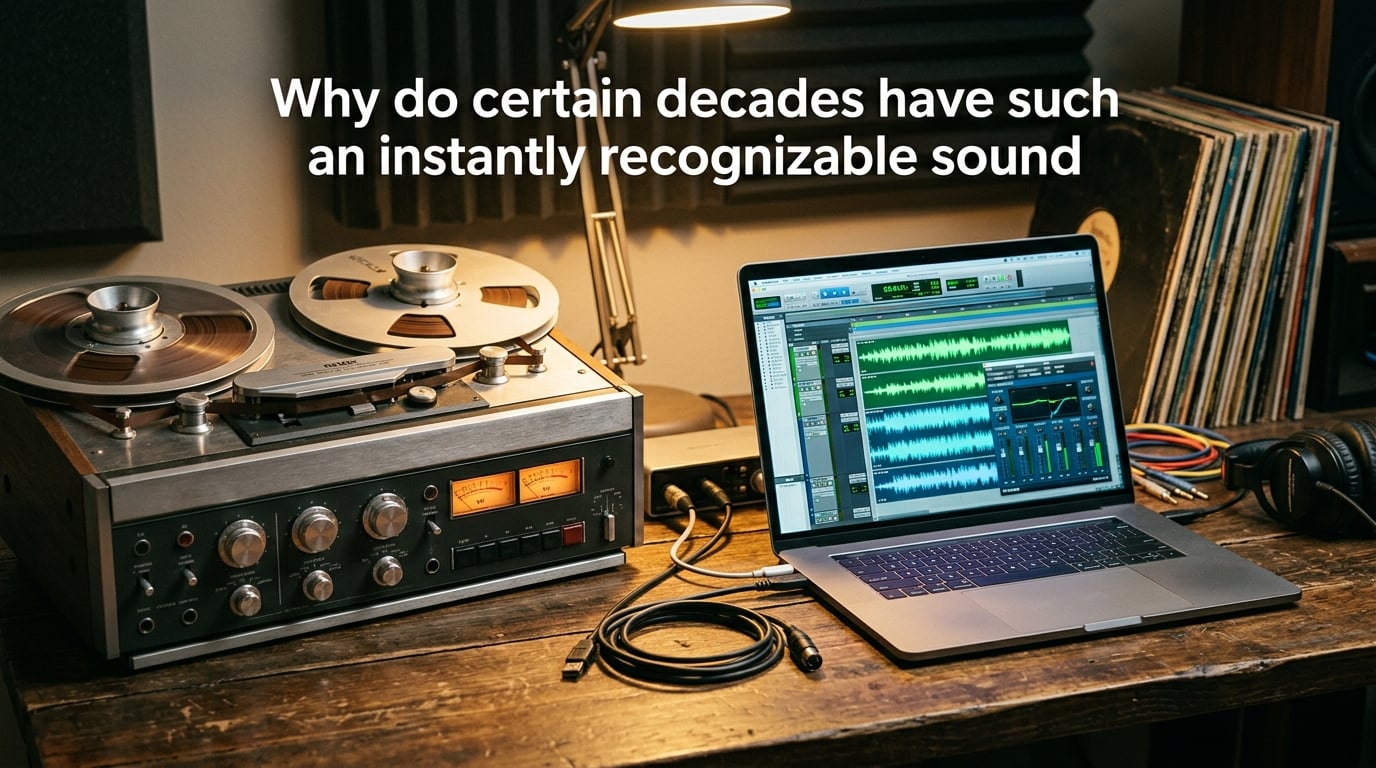
Certain decades have an instantly recognizable sound because five forces converge to set a sonic template: recording technology, signature instruments, mixing aesthetics, cultural mood, and the distribution platform that delivers the music. When a new technology goes mainstream, it filters through the era’s dominant genres and conventions until the next shift resets the template. That’s why your ear can place a song in a decade within a second.
I dug into this question for weeks, reading music-engineering forums, production blogs, and old Reddit threads. What follows is the mechanism behind that recognition, decade by decade, plus why the 2010s and 2020s feel blurrier than the 80s ever did.
On this pageTable of Contents
- What Makes a Decade Instantly Recognizable by Sound
- The Five Drivers Behind Every Era
- How Recording Technology Shapes Each Decade’s Sound
- From Acoustic to Multitrack Tape
- The Analog-to-Digital Transition
- DAWs, Plug-ins, and the Streaming Pipeline
- Decade-by-Decade Sound Signatures
- The Era-Defining Template at a Glance
- Walking Through the Major Shifts
- Production Micro-Signatures: The Audio Fingerprints
- 80s Case Study: What Makes 80s Music Sound 80s
- 90s and 2000s Micro-Signatures
- 2010s and 2020s: Convergence and Compression
- Why Modern Decades Feel Less Recognizable
- Cultural and Industry Forces That Lock In a Sound
- Distribution Platforms as Era-Makers
- The 35-Year Nostalgia Cycle
- Regional Sound vs. National Decade
- Frequently Asked Questions
- What makes 80s music sound 80s?
- What is the 35 year rule in music?
- Why do all modern songs sound the same?
- Did pre-1900 decades have distinct sounds?
- What makes music from different cultures and regions sound different?
- The Takeaway
What Makes a Decade Instantly Recognizable by Sound
A decade’s sound is a fingerprint built from five interlocking drivers. Change any one of them and the template shifts. Change them together and you get a clean sonic break between eras.
The Five Drivers Behind Every Era
- Recording technology. The hardware and software used to capture and process sound (tape, multitrack consoles, synthesizers, drum machines, digital audio workstations) sets hard limits on what’s possible.
- Signature instruments. Specific tools become cultural shorthand: the Stratocaster in the 60s, the LinnDrum in the 80s, the MPC in the 90s, the autotune processor in the 2000s.
- Mixing aesthetics. How engineers treat reverb, compression, stereo width, and loudness is a learned style that evolves with the gear.
- Cultural context. Youth movements, fashion, politics, and slang all bleed into lyrical themes, vocal delivery, and rhythmic feel.
- Distribution platforms. Radio, MTV, CDs, Napster, iTunes, and Spotify each favor different song lengths, mixes, and formats, which producers chase.
Producers in r/audioengineering describe this convergence as “the production template.” When the template stabilizes, every hit in a given year starts to share the same reverb tail, the same drum sound, the same vocal treatment. Your brain catalogs that pattern without you knowing it, then fires when it hears it again.
How Recording Technology Shapes Each Decade’s Sound
Technology is the engine of change. Every leap in recording gear opens a door the previous generation couldn’t walk through, and producers rush through.
From Acoustic to Multitrack Tape
Pre-1950s recording was a single microphone capturing a live performance. You couldn’t fix a mistake later. The sound of the 1930s and 1940s is the sound of performance constraints: tight arrangements, strong singers, and acoustics that matched the room. When Les Paul popularized overdubbing in the late 1940s and Ampex brought multitrack tape to studios in the 1950s, the rules flipped. Suddenly you could stack vocals, layer guitars, and edit takes together.
The Analog-to-Digital Transition
The 1980s introduced the digital reverb unit, the 12-bit sampler, and the MIDI standard that let synths talk to drum machines. Producers in r/mixingmastering still point to gated reverb on snare, parallel compression on vocals, and the LinnDrum’s distinctive kick and snare samples as the sonic shorthand of that decade. By the 1990s, Pro Tools and ADAT digital tape made recording cheap enough that a band could cut an album in a bedroom.
DAWs, Plug-ins, and the Streaming Pipeline
The 2000s made the digital audio workstation (DAW) the default studio. Plug-ins replaced hardware. By the 2010s, a teenager with a laptop and a copy of Ableton could make a record that competed with major-label releases. Today, streaming platforms normalize loudness across tracks so songs sit at similar volumes on a playlist, which pushes mastering toward a dense, bright, narrow template.
Decade-by-Decade Sound Signatures
Here is a compact snapshot of how each decade’s tech and culture combined into a recognizable template. Use it as a reference whenever you hear a song and want to know why it sounds like it does.
The Era-Defining Template at a Glance
| Decade | Defining Technology | Signature Instruments | Cultural Marker |
|---|---|---|---|
| 1950s | Multitrack tape, 7-inch single | Electric guitar, upright bass, snare kit | Rock and roll, AM radio |
| 1960s | 4-track and 8-track tape | Fuzz pedal, Rickenbacker, Hammond organ | British Invasion, counterculture |
| 1970s | 16- and 24-track tape, plate reverb | Moog synth, wah pedal, electric piano | Disco, prog rock, FM radio |
| 1980s | Digital reverb, MIDI, LinnDrum | DX7 synth, Simmons drums, gated snare | MTV, synth-pop, glam metal |
| 1990s | Digital tape (ADAT), Pro Tools | TR-808, MPC, grunge guitar stack | Grunge, hip-hop golden age, alternative radio |
| 2000s | DAWs, Pro Tools HD, autotune | Vocal processor, crunk drum, beat machine | iTunes, emo, ringtone culture |
| 2010s | Loudness normalization, bedroom DAWs | Sidechain synth pads, 808 glide, vocal chops | Spotify playlists, EDM, SoundCloud rap |
| 2020s | AI mastering, immersive audio | Short-form vocal hooks, hyperpop vocal edits | TikTok snippets, global K-pop crossover |
Walking Through the Major Shifts
The 1950s kicked off the modern era of recorded music because rock and roll arrived just as 45 RPM singles and AM radio made distribution national. The 1960s stacked four and eight tracks of tape to build the wall-of-sound Phil Spector became famous for. The 1970s expanded to 24-track tape and let bands like Pink Floyd and Fleetwood Mac build dense studio albums that simply weren’t possible a decade earlier.
The 1980s is the era forum users ask about most, and for good reason. Three things happened at once: digital signal processing hit the mainstream, MTV launched in 1981 and made visual identity inseparable from sound, and the LinnDrum drum machine standardized beat making. Every one of those shifts left a fingerprint you can still hear today. The 1990s traded the LinnDrum’s tinny snap for the deep boom of the TR-808 and the swing of the Akai MPC, then layered grunge guitars through stacks of pedals into tape-saturated consoles. The 2000s normalized autotune as a stylistic effect rather than a corrective tool, and the 2010s pushed every element of a mix toward the loud, bright, bass-heavy reference that streaming algorithms reward.
Production Micro-Signatures: The Audio Fingerprints
This is the layer most listeners feel but few can name. Production micro-signatures are small, deliberate choices engineers make on every track that signal a specific era. Once you learn to hear them, you can date a song without ever seeing the release year.
80s Case Study: What Makes 80s Music Sound 80s
The most repeated answer on Reddit’s r/explainlikeimfive comes down to three production traits: opera-like vocals (wide vibrato, big range, chorused stacks), heavily reverberated rhythm tracks (gated reverb on snare, plate reverb on drums), and a bass-led melodic scheme where the bass guitar carries the tune and the treble instruments link melody to beat. Add the gated snare trick (popularized by Phil Collins on “In the Air Tonight”), LinnDrum clap and cowbell samples, chorused lead synths, and a bright, glossy mix, and you have a checklist that lands 90 percent of the time.
90s and 2000s Micro-Signatures
The 90s traded reverb for impact. The TR-808’s long, boomy kick drum became the foundation of hip-hop and then pop. Producers leaned on MPC swing to push hi-hats off the grid, used grunge-rock tape saturation for warmth, and stacked distorted guitars until the walls of the mix disappeared. The 2000s made autotune a vocal effect (T-Pain’s “Buy U a Drank” is the textbook example), introduced sidechain compression to duck the bass every time the kick hit, and pushed vocals forward with bright plate reverb and aggressive de-essing.
2010s and 2020s: Convergence and Compression
The 2010s and 2020s feel blurrier because the production template converged across genres. Loudness normalization on streaming platforms rewards a narrow loud range. Global production templates mean a hit in Seoul, Lagos, and São Paulo uses the same kick sample pack. The signature micro-cues are still there (808 glide basslines, vocal chops, sidechain pumping synth pads, and TikTok-shaped three-second intros), but they’re mixed so similarly across genres that they read as one continuous template rather than decade-specific moves.
Why Modern Decades Feel Less Recognizable
Five forces work together to flatten the sonic signature of recent decades, and they’re the reason listeners keep asking why modern songs all sound the same.
- Streaming rewards familiarity. Playlists are built to keep listeners from skipping, so producers lean on reference tracks that already work, recycling drum sounds, chord loops, and mix balances.
- Loudness normalization. Platforms like Spotify and YouTube compress dynamic range so every track sits at a similar perceived volume, which pushes the entire industry toward the same dense, bright mix.
- Global production templates. A producer in Stockholm and a producer in Atlanta often use the same sample packs, the same plug-ins, and the same mixing references, which shrinks regional variation.
- Faster genre turnover. Subgenres now rise and fall in months instead of years, so no single template holds long enough to feel like “the decade.”
- The 24/7 release cycle. Constant new music means listeners don’t sit with one era’s hits long enough for the template to crystallize in memory.
None of this means modern music lacks identity. It means identity now lives at the micro level (a vocal inflection, a specific 808 tuning, a quirky synth patch) rather than at the macro level of a shared decade-wide template.
Cultural and Industry Forces That Lock In a Sound
Technology alone doesn’t explain why a decade sounds like itself. Cultural mood and industry structure are equally powerful locks.
Distribution Platforms as Era-Makers
Each new platform reshapes the music that wins on it. AM radio in the 1960s favored short, hooky singles. MTV in 1981 made visuals inseparable from sound, which pushed artists toward flamboyant fashion and short, punchy songs. The CD era of the 1990s rewarded longer albums and dynamic range. iTunes in 2003 made the single the dominant unit again. Spotify’s algorithm-driven playlists from 2008 onward pushed everything toward the same loud, hooky, algorithm-friendly target.
The 35-Year Nostalgia Cycle
Researchers have noticed that mainstream culture tends to re-embrace the sounds of about 35 years earlier. The 1990s revival of 1960s psychedelia, the 2010s revival of 1980s synth-pop, and today’s Gen Z obsession with 80s production aesthetics all fit that pattern. The cycle is reinforcing: every generation samples, covers, or imitates the music of its cultural grandparents, which keeps older templates alive in listeners’ ears and slows the perception that the new decade has truly arrived.
Regional Sound vs. National Decade
Detroit techno, Seattle grunge, Memphis rap, and Nashville country are all examples of regional scenes that briefly reshaped the national sound. They tend to crest fast, then either spread (grunge in the early 90s) or remain cult favorites (Detroit techno). The decade signature you’re recognizing is usually the average of several regional peaks that happened to line up with a distribution shift.
Frequently Asked Questions
What makes 80s music sound 80s?
Three production traits define the 80s template: opera-like vocals with wide vibrato and chorused stacks, heavily reverberated rhythm tracks (especially gated reverb on snare), and a bass-led melodic scheme where the bass carries the tune. Add LinnDrum drum samples, bright synth leads, and a glossy high-frequency mix, and most listeners can place a song in the decade within seconds.
What is the 35 year rule in music?
The 35-year nostalgia cycle is the observation that mainstream culture tends to re-embrace the sounds, fashion, and aesthetics of about 35 years earlier. The 1990s revival of 1960s psychedelia, the 2010s revival of 1980s synth-pop, and today’s Gen Z obsession with 80s production all fit the pattern, and the cycle reinforces itself by keeping older templates alive in listeners’ ears.
Why do all modern songs sound the same?
Modern songs feel similar because streaming rewards familiarity, loudness normalization compresses dynamic range across playlists, global production templates spread the same sample packs and plug-ins worldwide, and subgenres turn over faster than ever. Identity now lives at the micro level (a vocal inflection, a specific 808 tuning, a quirky synth patch) rather than at the macro level of a shared decade-wide template.
Did pre-1900 decades have distinct sounds?
Pre-1900 decades did have distinct sounds, but the changes happened more slowly and stayed closer to regional traditions. The Baroque, Classical, and Romantic periods each had their own harmonic language, orchestration choices, and performance conventions, and listeners trained in those traditions can date an unfamiliar piece within a generation or two the same way modern listeners can place a pop song in its decade.
What makes music from different cultures and regions sound different?
Regional variation comes from tuning systems, scale preferences, rhythmic patterns, instrument traditions, and local production aesthetics. The same forces that shape decade signatures (available gear, cultural mood, distribution channels) work at the regional level, which is why Detroit techno, Seattle grunge, and Memphis rap each sounded distinct from the national average when they peaked.
The Takeaway
Decades sound recognizable because recording technology, signature instruments, mixing aesthetics, cultural mood, and distribution platforms all move together, then lock in for a few years until the next shift breaks the mold. The 80s hit a perfect storm of MIDI, MTV, and LinnDrum that no later decade has matched because the modern streaming era flattens differences instead of amplifying them. Your ear isn’t doing magic; it’s matching production micro-signatures it learned the last time you heard a track from that era, and the cycle keeps the pattern alive through nostalgia and sampling.
Next time a song plays and you immediately know the decade, listen for the reverb tail on the snare, the drum-machine choice, the vocal treatment, and the length of the intro. Those four cues will tell you almost everything about when and how the track was made, and how the cultural mood of that moment shaped what listeners expected to hear.