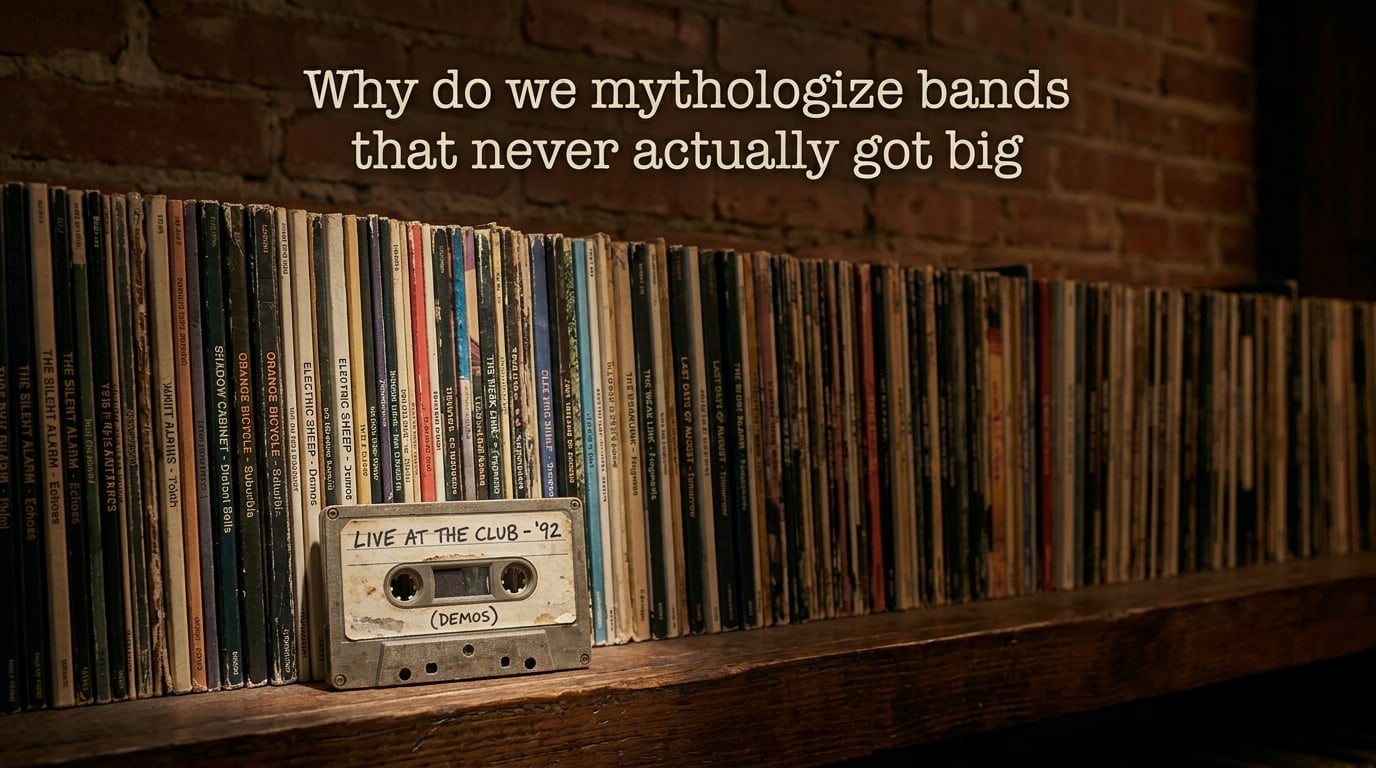
I have a confession that will probably get me banned from at least three music subreddits: I will defend Failure’s Magnified to anyone, and I have never once met another person on the street who has heard of Failure.
That gap — between my quiet, slightly embarrassing devotion and the band’s actual commercial footprint — is exactly what this essay is about. Why do we mythologize bands that never actually got big? Why do under-the-radar musicians get treated as sacred objects while stadium-fillers get treated as wallpaper? Why does obscurity itself become a credential?
Below, I’ll walk through the psychology, the industry mechanics, the canonization lag (the 35-year rule), and how streaming has changed the speed at which overlooked acts become legends. I will also name five cult bands who earned the devotion, and one or two who probably did not. By the end, you should have a working theory for why your favorite unknown band really matters to you — and why that matters culturally.
On this pageTable of Contents
- 5 reasons we mythologize bands that never got big
- What It Means to Mythologize a Band
- The Psychology of Mythologizing Obscure Bands
- Scarcity and the scarcity instinct
- Nostalgia bends the score
- Tribal identity and taste as cultural capital
- Authenticity signaling
- The discovery reward
- Why Some Bands Fade from Public Memory
- The Canonization Lag and the 35-Year Rule
- Case Studies: Bands That Got Mythologized After the Fact
- Big Star
- Hüsker Dü
- Failure
- Meat Puppets
- Slint
- Influence Without Sales: The Cult Band Phenomenon
- When Mythologizing Is Undeserved
- Streaming, Bandcamp, and the TikTok Ruins
- Frequently Asked Questions
- What is the 35 year rule in music?
- Why do some rock and roll bands fade from public memory?
- Why did these rock and roll bands have influence despite low sales?
- What makes a band a cult band?
- How do forgotten bands get rediscovered?
- Why are there no good rock bands anymore?
- The Bands We Choose to Remember
5 reasons we mythologize bands that never got big
- Obscurity reads as authenticity. Mainstream success is suspicious; being overlooked feels like proof the music is for insiders, not for algorithms.
- Scarcity triggers value. We assign more worth to things that are rare, hard to find, and almost forgotten.
- Discovery is identity. Finding a band before anyone else gives you cultural capital — a taste trophy you can carry into conversations.
- Nostalgia bends the score. Bands we loved in our formative years accrue reverence even if they barely sold records at the time.
- Influence outlasts sales. Many overlooked bands shaped later stars (Hüsker Dü into Nirvana, Big Star into R.E.M.), and that influence rewrites their place in the canon.
What It Means to Mythologize a Band
Mythologizing a band means treating their catalog as a sacred text — something that signals taste, identity, and depth, regardless of how many people actually bought the records.
A mythologized band is not the same as a merely forgotten band. Forgotten bands leave almost no trace; they released records, the records went nowhere, and most people have no opinion about them at all. Mythologized bands leave a deeper footprint. They have devoted defenders, critical reappraisals, reissues, reunion tours, and lines of influence that run through bands everyone does know.
Four characteristics separate the mythologized from the forgotten:
- Active defenders. Real fans who will argue for the band at parties, in comments, on message boards.
- Critical reappraisal. Reviews, retrospective essays, or documentaries that reframe the band’s place in history.
- Lineage. Later, more successful bands cite them as an influence. The mythologized band becomes a node in a tree, not just a leaf.
- Reissue economics. Labels can put out expanded editions, box sets, or remastered vinyl and find an audience. There is money in the mythology, even if there never was in the original sales.
When all four exist together, you have a cult band in the full sense — not just an overlooked one.
The Psychology of Mythologizing Obscure Bands
If we want to understand why fans do this, we have to start inside the listener. I have watched myself do it. I have watched friends do it. The behavior is oddly consistent across decades and genres.
Scarcity and the scarcity instinct
Scarcity principle: we want what is rare. A record that barely pressed 5,000 copies feels more valuable than a record that pressed 5 million. The same song on a $30 reissue feels more important than the same song streamed on a free tier. We are not being rational about this — we are running ancient software that read “rare” as “important, possibly dangerous, worth paying attention to.”
Nostalgia bends the score
Most of us discover bands during our formative years, when music feels like oxygen. If a band reached us then, their relative obscurity later does not retroactively erase the feeling. In fact, obscurity can intensify it. The song becomes a private time capsule.
Tribal identity and taste as cultural capital
Knowing obscure bands is a way of announcing who you are. Dropping Big Star’s #1 Record in a conversation does cultural work that dropping a Drake album does not. It tells the room: I have done the work, I have dug, I am not a casual listener. Music taste is one of the cheapest, most portable forms of cultural capital we have, and obscure bands are the high-denomination bills.
Authenticity signaling
Mainstream success is, in some music circles, treated as a mild contaminant. The bigger a band gets, the more they are suspected of compromising. Obscurity, by contrast, reads as purity — proof that the band was making art for art’s sake, not for the charts. This is partly true and partly a fairy tale. Plenty of obscure bands made cynical music; plenty of huge bands made transcendent music. But the signal of obscurity still does work in our heads.
The discovery reward
Finding a band before anyone else gives a small but real dopamine hit. It is the same reward pattern as finding a $20 bill on the sidewalk. The hit wears off when everyone else finds them too, which is why every indie fan has felt the strange deflation of seeing their secret band mentioned in a Netflix show or a TikTok trend. Mythologization depends, in part, on the band still being yours.
Why Some Bands Fade from Public Memory
Not every overlooked band gets mythologized. Most simply disappear. To understand why some last in memory and others don’t, it helps to understand why bands fade in the first place.
Five forces, repeated in interviews and biographies, do most of the damage:
- Bad label decisions. A major label signs a band, drops the wrong single as the lead, buries the album, and pulls the tour support. Mother Love Bone, Sevendust, From Zero — the stories vary, but the pattern is depressingly common.
- Tragedy. The death of a frontman ends more bands than creative differences ever do. When Andrew Wood died, Mother Love Bone died with him; when an accident takes a key songwriter, the survivors lose both the engine and the will.
- Scene oversaturation. Some eras produce more great bands than the marketplace can absorb. The late 80s alt-rock explosion, the early 90s shoegaze wave, the mid-2000s blog-rock era — all of them had bands that should have been bigger and simply got crowded out.
- Image problems. Bands that look wrong for their moment get punished even when the music is right. Wrong haircut, wrong city, wrong genre signifiers.
- Being ahead of the curve. Some bands are early. They release the album that will define 1995 in 1991, and nobody is listening yet. By the time the audience catches up, the band has broken up.
Each of these is enough on its own. Most mythologized bands stack two or three.
The Canonization Lag and the 35-Year Rule
Here is the strangest part of the whole phenomenon. Mythologization is rarely immediate. It usually takes about 35 years for an overlooked act to start getting the reverence their work deserved in real time.
The 35-year rule in music is the observation that an act’s influence and reputation tend to peak roughly three to four decades after their active years. Big Star was a commercial failure in the early 70s. By the mid-2000s, they were on every credible “greatest albums” list and cited as a primary influence by R.E.M., the Replacements, and Teenage Fanclub.
Why does this lag exist? Three reasons:
- Influence needs time to ripple. Band A influences Band B who influences Band C. By the time Band C is famous, Band A is two generations upstream and easy to forget.
- Critics rewrite the canon after the marketers leave. Initial coverage is shaped by what is being sold. Decades later, retrospectives are written by people who came to the music without any sales pitch attached.
- The original audience grows up and acquires platforms. The teenagers who loved the obscure band in 1985 are editors, professors, label owners, and festival bookers in 2026. They push the band into the canon because the band was formative for them.
This is why so many of the acts we now call legendary were financial failures in their own time. The reverence has to wait for the audience to accumulate the power to confer it.
Case Studies: Bands That Got Mythologized After the Fact
The abstract argument is easier to feel when it lands on a band you love. Five short examples of canonization in motion:
Big Star
Released three perfect power-pop albums between 1972 and 1978. Sold almost none of them. By the 90s, they were being cited as the secret origin of everything good in American indie rock. #1 Record and Radio City are now standard entries in every “best albums” list, and Big Star is a canonical reference point.
Hüsker Dü
Land Speed Record, Zen Arcade, New Day Rising — a catalog that arguably invented American post-hardcore and pop-punk. Toured relentlessly, sold modestly, and imploded in 1988. By the mid-90s, every band from Green Day to the Foo Fighters was citing them. The devotion stuck.
Failure
Two major-label albums in the mid-90s — Magnified and Fantastic Planet — that critics loved and almost nobody bought. The band broke up, the records went out of print, and then slowly, over fifteen years, the cult assembled. By the time they reunited in 2014, A Perfect Circle, Mastodon, and Tool were publicly citing them as an influence. Mythologization in real time.
Meat Puppets
Punk legends who went psychedelic country and lost their audience, then got a strange second wind via Nirvana’s MTV Unplugged performance of three of their songs. That single moment turned a respected cult band into a household reference, and the reissues have never stopped.
Slint
Spiderland came out in 1991, sold almost nothing, and is now considered one of the most influential post-rock records ever made. The 35-year rule in textbook form: a band that was invisible in real time, now cited as foundational by Mogwai, Explosions in the Sky, and most of the American math-rock scene.
Notice the pattern. In every case, the original run was commercially quiet. The reverence arrived decades later, through reissues, critical retrospectives, and influence that propagated forward into bands that did get big.
Influence Without Sales: The Cult Band Phenomenon
This is the part that still surprises me. Some of the most influential rock bands of the last fifty years had sales numbers that would get them dropped from a major label in a heartbeat.
Failure shaped the sound of A Perfect Circle, Tool, and a generation of moody alt-metal bands. Hüsker Dü gave Bob Mould and Grant Hart a template that built Sugar and Nova Mob, and a sound that traveled forward into Pixies, Nirvana, and the entire alt-rock wave of the 90s. Big Star’s Alex Chilton wrote songs the Replacements spent a decade trying to write. None of these lineages would have happened without the cult bands at the head of them.
Influence is a strange currency. It doesn’t show up in SoundScan numbers, it doesn’t register in Spotify monthly listeners, and it doesn’t move units. But it changes what later generations think music is allowed to sound like. When the bands that learned from Failure become headliners, Failure becomes a node in the canon even though they never sold records.
That is why the mythologizing happens. The mythologization is, in many cases, just the slow realization that a band mattered more than their sales figures suggested.
When Mythologizing Is Undeserved
I want to be honest about something the genre usually isn’t. Not every obscure band deserves the devotion. Mythologization is a cultural process, and like any cultural process, it gets things wrong.
Sometimes a band gets canonized mostly because they were there at the right time, in the right scene, with the right friends. A mid-tier post-punk band from 1981 London might be more mythologized than a better band from Dayton in 1987 because the London band shows up in more books. Proximity to the canon is not the same as merit.
Sometimes nostalgia is doing the work. A band that sounded fresh when you were 17 might sound thin when you revisit it at 40. But because the memory is precious, the music gets a pass it doesn’t deserve. We mythologize our own pasts through the bands that soundtrack them, and that is a sentimental error more than a critical judgment.
And sometimes obscurity is the right verdict. There are bands from every era who were competent, hardworking, and never broke through because they were, on balance, mid. The cult mythologization of every obscure act is a kind of flat-earth theory of music — it imagines that taste alone determines who gets remembered, when in fact quality, timing, luck, and taste all collide.
The honest answer is that some of the bands we worship earned it, and some of them were just lucky enough to be loved by people who later got loud. Knowing the difference is part of growing up as a listener.
Streaming, Bandcamp, and the TikTok Ruins
The 35-year rule was built for the analog era. The streaming era has changed the curve — and in some ways, it has made mythologization faster, stranger, and more manufactured.
Four mechanics now drive the engine:
- Bandcamp and Bandcamp Friday. A direct-to-fan platform where small bands keep most of the revenue, and where crate-digging is built into the UI. A band with 800 monthly listeners on Spotify can have a devoted Bandcamp following that buys every release.
- Spotify editorial playlists. A single placement on a curated playlist like Discover Weekly or a mood-based editorial list can add tens of thousands of listeners overnight. The algorithm can manufacture a cult following faster than any word-of-mouth ever did.
- TikTok ruins. A snippet of an old song goes viral on TikTok and suddenly a forgotten 1987 deep cut has more streams in seven days than it had in seven years. Kate Bush’s “Running Up That Hill” is the canonical case, but the mechanism now operates constantly, on bands that were never going to have a Stranger Things moment.
- Record Store Day reissues. An annual event that turns reissues into canonization rituals. Limited vinyl runs sell out in minutes, and the bands whose catalogs get the reissue treatment are being quietly anointed by the industry as historically important.
The result is that mythologization now happens in months, not decades. A band can go from 10,000 monthly streams to “forgotten classic rediscovered” in a single editorial cycle. This is faster, more democratic in some ways, and more suspect in others. When the canon is being assembled by algorithms, the long-tail obscurity of a Big Star becomes harder to replicate. The Bandcamp kids of 2025 may never get the 35-year window; they get the 35-day window instead.
That changes the meaning of mythologization. A canon built over decades reflects sustained influence. A canon built over a news cycle reflects whatever the algorithm surfaces. Both are real, but they are not the same kind of real.
Frequently Asked Questions
What is the 35 year rule in music?
The 35-year rule is the observation that an act’s reputation and influence tend to peak roughly three to four decades after their active years. Bands that sold poorly in their own time are often canonized, reissued, and cited as foundational influences once enough time has passed for their downstream impact to become visible. Big Star in the 70s and Slint in the early 90s are textbook examples.
Why do some rock and roll bands fade from public memory?
Most fade for one or more of five reasons: bad label decisions, tragedy (often the death of a key member), scene oversaturation that buries good bands in the noise, image problems that make them unreadable to their moment, or being ahead of the curve and breaking up before the audience catches up. Stacking two of these is usually enough to end a band’s commercial life.
Why did these rock and roll bands have influence despite low sales?
Because influence is a different currency than sales. A band’s sound can shape what later, more successful bands decide to play, and that downstream impact eventually rewrites their place in the canon even though they never moved units. Failure shaped A Perfect Circle and Tool; Big Star shaped R.E.M. and the Replacements. The mythologization is just the slow realization that a band mattered more than their sales suggested.
What makes a band a cult band?
A cult band has four characteristics together: active defenders who will argue for them in any room, critical reappraisal in the form of retrospectives or documentaries, a clear lineage into more famous later bands, and reissue economics that prove there is an actual market for their back catalog. Any one of these on its own is not enough. All four together is a cult band in the full sense.
How do forgotten bands get rediscovered?
In the streaming era, four mechanisms do most of the rediscovery: Bandcamp and similar direct-to-fan platforms that preserve and surface small catalogs, Spotify editorial playlists that can add tens of thousands of listeners overnight, TikTok virality that can take a 1987 deep cut from obscurity to viral in a week, and Record Store Day reissues that turn catalog releases into canonization rituals.
Why are there no good rock bands anymore?
There are plenty of good rock bands; the discovery curve has changed. Algorithmic playlists and TikTok shape attention in news cycles rather than decades, so fewer bands accrue the long, slow, scene-driven mythology that produced bands like Big Star or Slint. The bands exist. The 35-year window that turned overlooked acts into legends largely does not.
The Bands We Choose to Remember
So why do we mythologize bands that never actually got big? Because mythologization is how music history actually gets written. Sales charts record what was popular; mythologization records what mattered. The two overlap, but they are not the same thing, and most of the time the canon gets the more interesting story.
It works because of us — the listeners who do the digging, write the long Reddit comments, buy the reissues, and push the obscure bands into the lineage charts. Without that devotion, Big Star stays forgotten. With it, Big Star becomes a touchstone for half of American indie rock.
It is also, I think, a slightly more honest relationship with art than the one the mainstream tries to sell. We get to choose which overlooked acts we are going to carry forward. That choice is not always correct, and I argued above that some of it is sentimental noise. Still, it is a choice, and it is one of the few places where being a music fan actually builds something rather than just consuming it.
Tell me your mythologized band. The one you carry around that no one else seems to. I want to know who your Failure is, who your Big Star is, who your Slint is. The canon is built from those conversations, and the canon is always still being written.